
Construction robotics is emerging as a candidate control layer for reducing variability in project production systems. Its early-stage deployment phase introduces a novel prioritization problem: small robotics teams must decide, deployment by deployment, which operational friction to solve through product investment versus which to handle through operator workarounds and standard work. These decisions compound, and the wrong early bets can compromise adoption before the technology reaches steady-state performance.
This paper proposes a decision framework for R&D prioritization in early-stage autonomous construction robotics deployment. The framework applies four components of Operations Science principles that Project Production Management uses to analyze capital project overruns: (1) a resource taxonomy distinguishing ambient, premium, and new jobsite resources; (2) a three-tier decision model covering ambient-compatibility product investments, per-task product investments, and operational workarounds, with explicit handling of failure-triggered invocation math and product-to-product substitution; (3) a capability-envelope and observed-variance methodology that pairs lab characterization with field-distribution data for coverage-gap analysis; and (4) treatment of two under-recognized failure modes in field characterization: sampling bias, and margin stacking in two forms — a chained ambient-resource operation where link tolerances sum in series, and an on-floor precision budget where the orientation term is amplified by arm reach rather than merely summed.
The framework is illustrated through six cases drawn from the author’s work across 10 commercial envelope-installation deployments spanning 9 U.S. general contractors and 8 states (4,528 robot-hours as of April 2026, zero safety incidents, approximately 13,500 worker-hours of leading-edge fall exposure eliminated). Cases span physical form factor and digital asset integration, demonstrating the framework’s transferability across both mechanical and digital dimensions of early-stage deployment.
The paper contributes a repeatable method for a class of decisions currently made ad hoc across the emerging construction robotics industry. Primary audiences include robotics practitioners working toward steady-state deployment and capital project stakeholders integrating these systems into active project delivery. Future work will extend the framework to safety-critical control, communication redundancy, and operator training dimensions.
Keywords: Project Production Management; Construction robotics; Decision framework; Variability management; Early-stage deployment; Building envelope installation; Ambient resource compatibility; R&D prioritization

Kenrick Tjandra is Robotics Deployment Lead at Raise Robotics, where he has led over 10 commercial deployments across 8 states for tier-1 general contractors including DPR, Turner, and Hensel Phelps--logging more than 5,000 autonomous hours without a single safety incident. Kenrick designed Raise Robotics operator training framework, which was adopte ...

Rishabh Aggarwal is CTO, Raise Robotics, a San Francisco Physical AI company building autonomous mobile robots for heavy industry including shipyards, construction, and manufacturing. He previously worked at Tortuga AgTech, where he scaled an autonomous harvesting fleet from 1 to 150+ robots, earning recognition in TIME’s Best Inventions 2025.
On the first commercial deployment of an autonomous building-envelope-installation robot (Deployment 1, March 2024), the lab-validated default arm pose placed the robot’s top assembly above the standard interior ceiling of the construction hoist at the site. The deployment crew freedrove the arm into a folded pose on the loading dock, manually, before extending a hoist call. The deployment ran. The next product release reduced the default arm pose to fit inside the cabin envelope of the most common U.S. commercial construction hoist. One round of the field-to-product loop, one ambient-resource constraint resolved.
That kind of decision happens on every deployment of an early-stage construction robot. The authors have made that decision across 10 commercial envelope-installation deployments spanning 9 U.S. general contractors and 8 states, logging 4,528 robot-hours and eliminating approximately 13,500 worker-hours of leading-edge fall exposure without a single safety incident. The pattern that emerges across those deployments is the subject of this paper. Small robotics teams decide, project by project, which operational friction to solve through product investment and which to handle through operator workarounds. The decisions accumulate. Early misallocation of engineering capacity can compromise adoption before the technology reaches steady-state performance, a structural problem documented in the gap between venture-capital expectations and construction-technology fundamentals [1].
Prior PPI research has documented the cost of similar misallocation at established industrialized-construction firms. Tommelein and Coelho [2] describe a glazing fabricator that acquired a 16-axis cutting machine without analyzing its production-system implications, then absorbed 40–50% unplanned downtime from sensor fouling that broke the existing line flow. That firm operates well-tuned lean processes. Even so, the local automation investment degraded system-level performance. The case is a documented example of an investment that a decision discipline could have caught before acquisition.
Construction robotics in commercial application is younger than industrialized construction by decades [3], [4], and its deployment patterns are still being characterized [5]. Adoption barriers are well-documented at the firm and project level [6], [7]. What’s less documented is the decision discipline a deploying robotics team needs to allocate finite engineering capacity across the frictions that surface on every project.
This paper proposes such a discipline. The framework applies Operations Science principles [8] and the Project Production Management approach to capital project overruns [9]. The decision unit is the deployment team’s R&D prioritization question: change the product, change the operator playbook, or accept the friction. The framework has four components and treats two under-recognized failure modes. It’s illustrated through six cases drawn from the author’s work across 10 U.S. commercial building-envelope-installation deployments.
The remainder of the paper is organized as follows. Section 2 reviews how prior PPI work has analyzed automation at the production-system level and identifies the decision-discipline gap. Section 3 names the R&D prioritization problem in operational terms. Section 4 presents the framework. Section 5 illustrates it through six cases. Section 6 discusses implications and limitations.
PPI defines five production levers as the technical basis for analyzing project production systems: product design, process design, capacity, inventory, and variability [9]. An autonomous construction robot interacts with all five. As a new resource, it expands capacity. As a tighter performer with a smaller cycle-time variance than manual labor, it reduces variability. As an enabler of compressed task sequences (single-shift layout-and-install in one pass instead of sequential trades), it permits process redesign. Its physical envelope and required ambient inputs constrain what product (building-envelope) and inventory configurations a project can support.
Variability is the lever most directly affected by early-stage robotics deployment. Hopp and Spearman [8] formalize the cost of variability through the queuing relationship that links utilization, coefficient of variation, and effective cycle time. Variability in construction operations is well-documented in lean construction research; Thomas et al. [10] showed that variability in labor productivity correlates with project performance more reliably than variability in raw output. For a robot operating inside a project production system, two sources of variability matter: the variance of the robot’s own performance (lab-characterized capability envelope), and the variance of ambient site conditions the robot operates in (observed field distribution).
Recent PPI scholarship has begun to apply Operations Science to specific automation decisions in construction-adjacent settings. Louis, Mirhasani, and Said [11] propose a framework for product-process integrated analysis using Discrete Event Simulation (DES) coupled to Building Information Models (BIM). Their lever-mapping move (mapping each of the five PPI levers to a modeling method) anchors how joint product-and-process analysis can support production-system optimization. Zhang, Piao, and Fischer [12] apply Operations Science and Production System Optimization to evaluate a robotic wastewater-testing platform in China. Their finding (that cycle-time savings came largely from eliminating queuing time caused by process variability rather than from raw task-speed gains) parallels the variability-reduction value of construction robots. Tommelein and Coelho [2] frame the broader investment question: industrialized-construction decisions made without grounding in operations science can degrade production-system performance even at sophisticated firms.
The construction-robotics literature recognizes the absence of structured prioritization but addresses it at the industry-sector level rather than the deploying-team level. Cai et al. [7] surveyed U.S. and Chinese contractors and noted that “few studies have been conducted to identify the specific development priorities based on the needs in construction applications,” making it “difficult for researchers and robot developers to choose prioritized directions and carry out their work efficiently and effectively.” Their response was an expert workshop that produced six industry-wide development priorities. Adoption-barrier surveys [6] similarly catalog firm- and project-level obstacles without articulating a decision discipline for a deploying team. The gap this paper fills sits one level below: the R&D prioritization decision an early-stage deployment team faces project by project, where engineering judgment alone produces inconsistent allocation of finite engineering capacity across the frictions each project surfaces.
Every deployment of an early-stage construction robot surfaces frictions. Some frictions are mechanical (the robot doesn’t fit on the construction hoist at this site). Some are digital (the BIM model has overlapping geometries the importer can’t reconcile). Some are organizational (the GC’s BIM coordinator can’t schedule a re-issue inside the install window). Frictions cluster into three response paths: change the product, change the operator playbook, or accept the friction.
One class of friction sits outside this economic comparison. Where a deployment exists to remove a worker from a hazardous task — the leading-edge fall exposure the envelope-installation robot is built to eliminate — hazard elimination is a constraint on the framework, not a term inside it. Taking a person off the leading edge is not weighed against engineering capacity or cycle-time variance; it is the premise that justifies the deployment, and it holds even where the per-task economics are marginal. This mirrors the standard hierarchy of controls, in which elimination — removing the hazard, or removing the worker from it — is the most effective control, ranked above the substitution, engineering, administrative, and personal-protective controls beneath it [15]. The framework allocates finite R&D capacity among the residual frictions that remain once that constraint is met; it does not price the constraint itself.
The constraint also bounds the response set. Handling a friction by changing the operator playbook — standard work rather than product change — is an administrative control in that same hierarchy, and administrative controls rank near its bottom. Such a workaround is inadmissible whenever it would resolve a friction by returning a worker to the hazard the deployment was meant to eliminate, however cheap it is on ambient resources. Safety removes options from the choice set rather than entering the objective function. Within that boundary the framework serves exactly the purpose a hazard-elimination mandate requires: once elimination is fixed as the goal, the framework governs how to engineer it — which frictions to close through product investment and which to carry through standard work — not whether to pursue it.
The three paths have different cost profiles, different lead times, and different failure modes. A premature product investment consumes engineering capacity that is difficult to redirect once committed. A premature operational workaround becomes an embedded cost that scales with every subsequent deployment. Silently accepting a friction produces the highest expected long-run cost: variance compounds, and the team loses observability into where to invest next.
Two failure modes are under-recognized in early-stage field characterization, and both have surfaced repeatedly across the author’s 10 deployments.
The first is sampling bias in field-distribution data. The first three deployments don’t represent the next thirty. Decisions made on early samples often misread the shape of the underlying distribution. Two sub-modes matter in practice: a continuous-tail variant, where early sites over-sample one end of a continuous distribution (e.g., the high-fidelity end of the BIM-quality range); and a multimodal variant, where early deployments encounter only one mode of a multimodal distribution (e.g., flatbed deliveries, when smaller sites use box trucks).
The second is margin stacking in chained operations, in two forms. The first is a chained ambient-resource chain (truck, dock, forklift, hoist, doorway, floor): each link has its own tolerance, each tolerance is sized in isolation, and when the operations chain in series the margins consume each other, so a nominal margin that’s defensible at each step alone can vanish in aggregate. The second is an on-floor precision budget, where the tolerances that govern install accuracy stack at a single work location rather than across a material-handling chain, and one term, the orientation error, is amplified by the reach of the arm rather than merely summed.
The framework that follows is designed to make these decisions explicitly and to treat both failure modes as first-class inputs rather than afterthoughts.
The framework has four components. The first names the resources a robotics deployment relies on. The second names the response tier. The third overlays lab capability against field demand. The fourth treats the two failure modes named above.
A construction robot’s deployment cost depends on which jobsite resources it consumes. Three classes are useful (Table 1).
Table 1. Resource taxonomy for construction robotics deployment.
| Class | Definition | Cost profile | Examples |
|---|---|---|---|
| Ambient | Already on site for the GC’s work; the robot consumes operator-minutes only | Lowest; on the GC’s existing budget | Standard forklift, standard construction hoist, standard 120 V site power, standard access routes |
| Premium | Scheduled site resource competing with other trades for time | Dollar cost per use; schedule risk | Tower crane pick, specialized lift, rented oversized loader |
| New jobsite | Resource the site doesn’t already have; requires vendor coordination and logistics | Highest; risk of missing or late | Custom anchors, site-specific fixtures, narrow pallet jack |
The class determines the workaround-cost profile. A workaround that runs on ambient resources is cheap. A workaround that requires a new jobsite resource has logistics risk and dollar cost on every invocation.
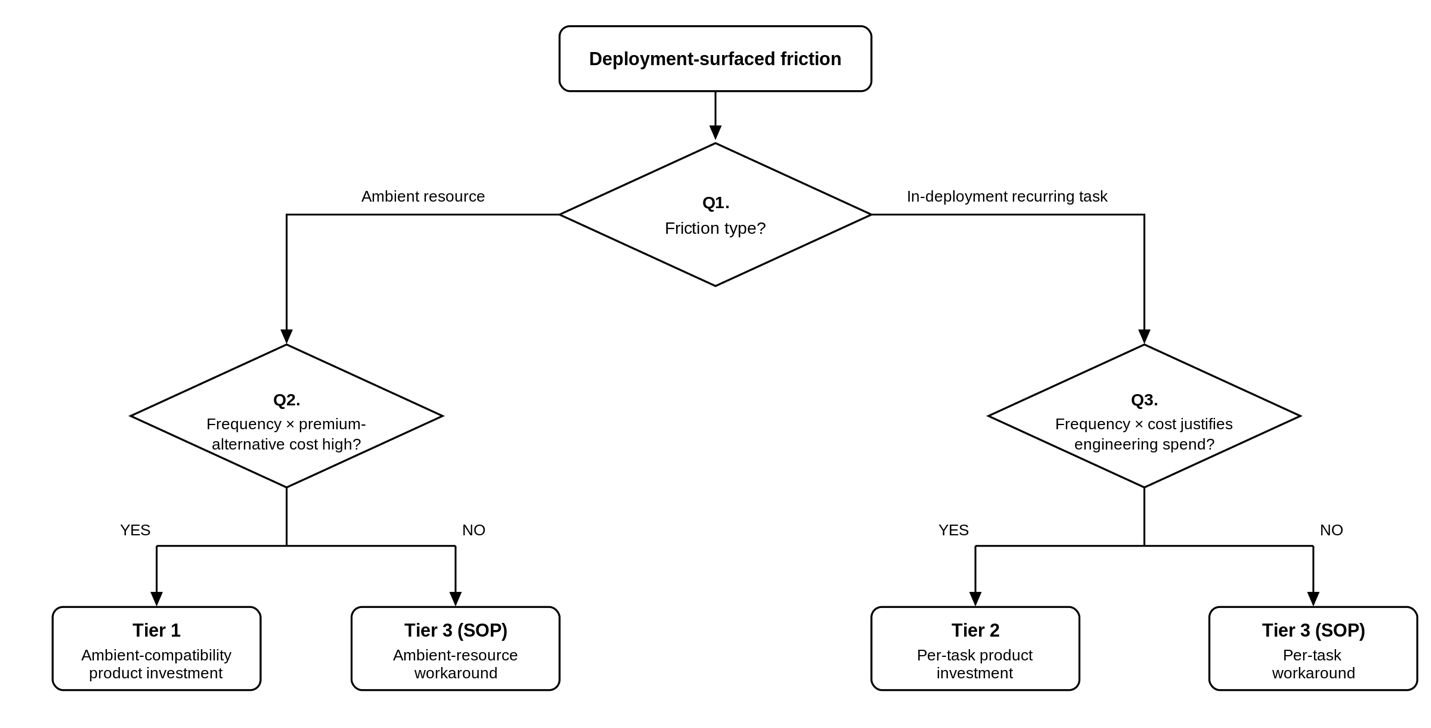
For any deployment-surfaced friction, three response tiers are available. Tier 1, ambient-compatibility product investment, is a one-time product design decision that qualifies the robot to use a resource the site already has (e.g., fitting the construction hoist envelope, fitting standard flatbed dimensions, drawing standard site power); its non-recurring engineering cost amortizes across every subsequent deployment that uses the resource. Tier 2, per-task product investment, is a recurring operational improvement where frequency times variability times schedule criticality justifies engineering spend (e.g., a drivetrain change that reduces motion primitives on a high-frequency in-deployment task). Tier 3, operator workaround (SOP), is the default for low-frequency tasks on ambient resources. A Tier 3 workaround is further bounded by the safety constraint of Section 3: no SOP may resolve a friction by returning a worker to an eliminated hazard, independent of its ambient-resource cost.
Tier 1 candidates are ranked by expected utility (frequency times the premium-alternative cost). Ambient-compat constraints can conflict. A robot narrow enough to fit a standard pallet jack’s fork pocket may be too narrow for the construction-hoist door clearance with margin for tool stowage. Constraints that lose the utility ranking are dropped, and a Tier 3 SOP carries the friction.
Tier 3 includes failure-triggered invocations. Some workarounds fire only when an upstream Tier 1 investment fails. The expected cost is P(failure) × recovery_cost, not occurrence count times cost. When the failure-triggered cost is low (rare event, cheap recovery), upstream reliability investment dominates downstream recovery mechanism. For example, a recovery that fires on roughly one deployment in ten and costs on the order of two crew-hours carries an expected per-deployment cost near 0.2 crew-hours, far below the standing cost of provisioning every deployment against it; the comparison then favors a product-to-product substitution, investing in the reliability of the component whose failure triggers the recovery rather than equipping the downstream recovery on every deployment. This is the classic build-quality-in-versus-build-better-recovery decision (jidoka logic [8]).
The framework’s analytical step is to overlay two distributions: the validated capability envelope (the conditions the robot has been characterized and tested for, in lab) and the observed field distribution (what the deployments actually deliver). Figure 1 illustrates the overlay conceptually.
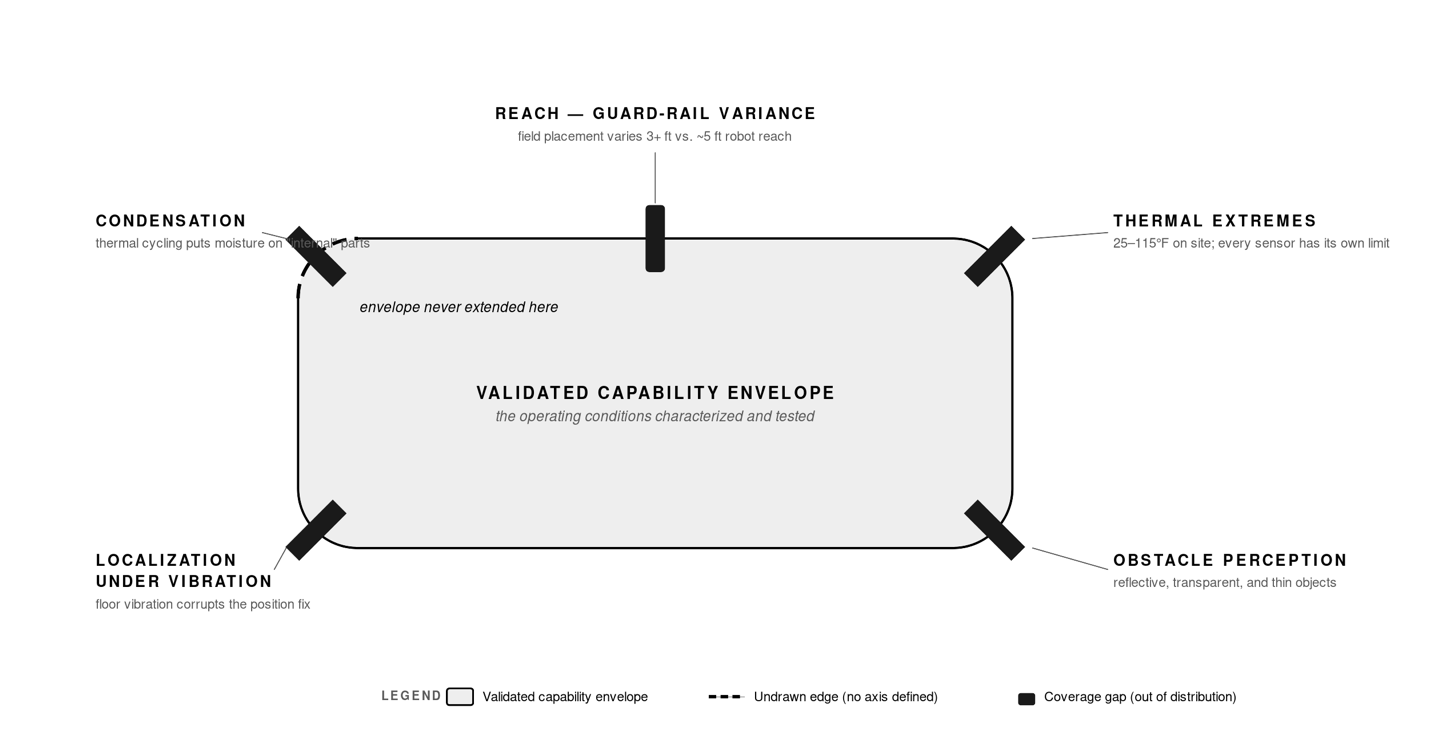
Coverage gaps identify Tier 1 candidates. A coverage gap that sits on the high-variance side of the field distribution is a candidate for ambient-compatibility investment. A coverage gap that sits on a low-frequency tail is a candidate for a Tier 3 workaround with failure-triggered invocation math. Coverage gaps also differ in structure. Some are single-investment gaps that one product change closes. Others are stacked gaps: the gap is itself an error budget that field demand breaches only when several ambient variances combine, so closing it takes a coordinated set of Tier 1 investments rather than one. The on-floor precision budget treated in Component 4 is the clearest example of a stacked gap.
Both failure modes require structural treatment built into the framework.
Sampling bias. Before any variance statistic is computed from the deployment dataset, the dataset is stratified by site-condition class (site geometry, GC type, crew experience, transport mode). A continuous-tail check inspects each class for over-sampled regions. A multimodality check looks for missing modes in categorical variables (transport vehicle, BIM file format, control-point source).
Margin stacking. Margin stacking appears in two forms, and both require an explicit margin-budget table. The first is a chained ambient operation (truck → dock → forklift → hoist → doorway → floor): each link’s tolerance is tabulated, summed in series, and checked against the actual envelope, and coverage analysis runs against the full chain, not against any single link. The second is an on-floor precision budget. Install accuracy is delivered at the work face, not in transit, through a local loop in which the robot parks, stabilizes, localizes against control points, then runs the arm to lay out and fasten before relocating. The terms that stack are the control-point and datum uncertainty, the base-leveling residual after stabilization, the localization registration, and the arm’s kinematic residual. This budget differs from the logistics chain in one structural way: it is not purely additive, because the orientation term is amplified by a geometric factor, the reach of the arm, so a one-degree tilt at roughly 1.27 m of reach contributes about 22 mm at the tool. The margin-budget table for a precision chain therefore carries amplification factors, not only sums, and coverage runs against the amplified total. Case 6 illustrates a coverage gap of this second kind, closed by a coordinated set of Tier 1 investments rather than a single one.
Figure 2 (decision tree) summarizes how a deployment-surfaced friction is routed through the framework.
Six cases from the author’s deployment record illustrate the framework. Project and contractor names are anonymized as Deployment N (in chronological order, D1 through D10). The cases collectively touch each component of the framework and both failure modes.
Every deployment begins with offloading the robot from the delivery truck onto site. The task fires once per project, runs on the ambient forklift the GC already has (operator-minutes on the order of 15), and is consistent across all 10 deployments. The framework places it at Tier 3. An ambient-compatibility product investment to enable any other offload method would not be cost-justified by the task frequency. One edge case has surfaced: a forklift configuration with a center divider that produces fork-opening dimensions too wide for the robot’s fork pockets. The crew recovers by using the robot’s rigging points and treating the forklift like a small tower crane. The recovery runs on the same ambient resource; no Tier 1 or Tier 2 invocation is justified.
Inter-floor moves fire dozens of times per deployment on multi-story commercial envelope projects. The premium alternative (a tower crane pick to relocate the robot between floors) is expensive and schedule-critical against other trades. Standard U.S. commercial construction hoists cluster tightly on interior dimensions: the most common cars (Alimak Scando 650 FC and GEDA Multilift P22 families) have interior widths of 1.4–1.5 m, heights of 2.1–2.3 m, and payload limits between 2,000 and 3,200 kg [13]. The framework places this case at Tier 1. On Deployment 1 the lab-validated default arm pose placed the top assembly above the GEDA-class ceiling clearance. The field workaround was an operator-driven freedrive-and-fold on the loading dock. The permanent fix landed in the next product release: the default arm pose was reduced to fit the smallest common cabin envelope. The Tier 1 engineering cost amortized across every subsequent multi-story deployment.
Perimeter relocation on a single facade fires every ~3 mullions, hundreds to low-thousands of times per deployment depending on facade geometry. The first ten deployments ran a tracked base, which requires a 5-step tank-steer maneuver (back, rotate, move, rotate back, forward) per relocation. Internal time studies measure 130 seconds of active motion per relocation on the tracked base. The omnidirectional (mecanum) base that succeeded it reduces the same relocation to 2 motion primitives, with engineering-estimated active motion of 42 seconds per relocation, a 67.7% per-cycle reduction. The framework places this at Tier 2 on the frequency-times-cost test: 88 seconds of active-motion savings per relocation, multiplied across hundreds to thousands of relocations per deployment and again across the platform’s lifetime, produces engineering ROI sufficient to justify the per-task product investment. At the upper end of the relocation range (low thousands per deployment), cumulative active-motion savings approaches 24 hours per project; at the lower end (a few hundred), the savings is closer to 6 hours. Either bound, multiplied across the platform’s installed base, justifies the per-task product investment several times over.
A second consideration argues in the same direction. With two motion primitives in series instead of five, the per-relocation cycle time has fewer compounding error sources, and the coefficient of variation is expected to fall along with the mean. Hopp and Spearman’s [8] queuing relationship makes both the throughput gain and the variance reduction first-order contributors to system-level cycle-time improvement, so the framework’s Tier 2 routing of this case is grounded in two Operations Science levers simultaneously: capacity (faster cycle time) and variability (tighter cycle-time distribution).
A latent ambient-compatibility exclusion exists (mecanum bases handle rough floor finishes worse than tracked); the Tier 2 investment is paired with a Tier 3 pre-deployment SOP that screens floor-finish conditions before the omnidirectional base is committed to a site. The omnidirectional base shipped on Deployment 11 (May 2026); field validation will produce the measured cycle-time mean and variance in subsequent deployments.
The first nine deployments used standard flatbed delivery, with comfortable vertical clearance from the bed surface to any overhead constraint. Deployment 10 (a smaller San Francisco-area site, February 2026) used a box truck instead. The interior clearance dropped to ~2.4 m. The robot’s tallest configured pose is ~2.1 m, giving a nominal 0.3 m margin. The forklift extraction lifted the robot 0.1–0.15 m off the bed during offload, consuming roughly half the margin. The constraint was caught pre-deployment by the deployment crew’s pre-arrival checklist; the team rerouted to a different truck rental, at a cost of 2 hours of crew delay. The case illustrates both named failure modes. Multimodal sampling bias: the transport-mode distribution had two modes (flatbed and box truck) and the first nine deployments sampled only one. Margin stacking: clearance margins evaluated in isolation (truck-bed to ceiling, robot height, forklift lift height) were each individually defensible but consumed each other in series. The framework response was a Tier 3 SOP update: pre-deployment specification of truck type and forklift lift height now runs as a standard pre-arrival gate.
The first three deployments worked with Tier-1 general contractors operating mature BIM workflows; the model-ingestion pipeline appeared resolved as a deployment risk. Deployment 7 (a regional general contractor running a retrofit project in the Los Angeles area) shipped a BIM model with overlapping geometries, missing metadata, and the visible symptoms of a heavily-iterated, poorly-coordinated workflow. The ingestion pipeline stalled. The Raise team requested a model re-issue; the GC complied. The deployment delayed two days. The case illustrates the continuous-tail variant of sampling bias: the first three deployments oversampled the high-fidelity end of the underlying distribution. The framework response was a Tier 3 SOP update: a pre-deployment BIM fidelity gate now runs before any robot is mobilized to the site. The gate inspects revision count, overlapping geometries, and metadata completeness, and prompts a re-issue request to the GC if any of the three thresholds are breached. The case also demonstrates the framework’s transferability beyond mechanical form factor into digital asset integration.
Envelope-bracket layout and install is the one task that requires the end effector to hold a millimeter-scale tolerance against structure, and it is the on-floor precision budget of Component 4 in concrete form. The operational loop is local: at each work location the robot parks, stabilizes on its outriggers, localizes against control points, then runs the arm to lay out and fasten before relocating to the next. The Localization under vibration coverage gap in Figure 1 is where ambient floor and structure variance breaches this budget. A poured floor is level only to human and contractor tolerances, and a wheeled, sprung platform carrying a long-reach arm is compliant, so the amplified orientation term dominates and the arm referenced to its own encoders from a compliant base cannot meet the requirement. The gap is a stacked one in the sense of Component 3: it is an error budget breached only when several ambient variances combine, so it is closed by a coordinated set of Tier 1 investments rather than one.
Three Tier 1 investments close one dominant link each. An actuator stabilization mechanism, four corner-mounted electric ball-screw outriggers (not hydraulic) with dual linear shaft guidance, deploys in under ten seconds to lift the sprung wheel units out of the load path and seat the robot on a rigid, level base; compression load cells verify ground contact and a safety-rated PLC enables the arm only once all four legs read positive, with the drive and the stabilizers never powered at the same time. This removes platform compliance and vibration from the budget and resists the reaction forces of drilling and fastening. External localization ties the working point to site control points, so global position is measured rather than accumulated through the kinematic chain and is immune to arm compliance, backlash, and thermal drift, with chassis tilt recovered from the localization points at the platform against the work points at the structure. Machine-learning arm calibration then layers a learned regression, trained on several hundred laser-tracker pose measurements, on top of a geometric calibration, compensating the residual kinematic and non-kinematic errors of an affordable cobot, the harmonic-drive transmission error, backlash, link flexibility, gravity deflection, and thermal drift, and correcting orientation as well as position so the amplified term stays inside the budget.
The three are complements, not substitutes: the stabilizer establishes a rigid datum, localization supplies external position truth at it, and the learned calibration supplies orientation accuracy from it, and the gap closes only with all three in series. The case is the framework routing a stacked coverage gap to coordinated Tier 1 investment rather than to an operator workaround, since no SOP can recover millimeter placement from a compliant base. It also extends the framework’s reach: where the transport-clearance case (Case 4) shows margin stacking in a logistics chain, this case shows it in a precision budget at a single work location, the second form named in Component 4. Field metrology across installs gives a mean placement error of 0.067 in (1.7 mm) on one install axis and 0.013 in (0.3 mm) on the other, both at the millimeter scale the task requires.
The framework is a method for a class of decisions currently made ad hoc across the construction-robotics industry. It does not eliminate engineering judgment. It structures the inputs that judgment runs on (the resource class, the response tier, the capability-envelope overlay, the failure-mode treatment) and makes those inputs explicit.
The framework aligns with prior PPI findings on industrialized-construction investment decisions, and the Walters & Wolf case in Tommelein and Coelho [2] is the cleanest documented example of an investment the framework would have routed differently. The investment in question was a sophisticated 16-axis cutting machine that consolidated work from three stations at greater speed and precision. Applying the four framework components in sequence shows where the decision could have been caught before acquisition.
The resource taxonomy (Component 1) would have classified the cutting machine as a New jobsite resource consuming an unrecognized ambient dependency: sensor visibility against the chip-accumulation conditions of a metal-cutting shop. The three-tier decision model (Component 2) routes the case through Q3 (in-deployment recurring task, high frequency times high cost) toward Tier 2, but the failure that materialized (sensors fouled by cutting chips, with 40–50% uptime against a 90% baseline at adjacent stations [2]) was an ambient-compatibility failure that the Tier 2 framing alone does not surface. The capability-envelope component (Component 3) is the most direct fit. The manufacturer’s quoted speed was characterized under what Tommelein and Coelho describe as “optimal conditions,” which constitutes a lab-validated envelope that did not cover the observed field distribution of chip exposure on a glazing-fabrication shop floor. Overlay analysis before acquisition would have flagged the sensor-tolerance axis as a coverage gap (Type A in Figure 1: a known boundary whose breach by field demand was not measured). The sampling-bias and margin-stacking treatments (Component 4) reinforce the same finding: the “optimal conditions” caveat is a continuous-tail sampling bias toward controlled environments, and the chained operating margin (machine uptime, line balance, maintenance schedule, replacement-parts availability) consumed the planned takt-flow budget once the sensor failure rate materialized in series.
Collectively, the framework would have required either pre-acquisition characterization of sensor uptime under chip exposure, or the right-sized alternative the firm has since adopted for future investments [2]. Binsky & Snyder [2] is the constructive counterexample. Their pre-investment process mapping (assessing capacity, work-in-process, and bill-of-process detail before acquiring fabrication equipment) is what the resource taxonomy and three-tier decision model operationalize for a deploying robotics team. The framework does not invent that discipline; it imports it from a PPI peer firm into a class of decisions that early-stage construction-robotics teams currently make without it.
Limitations. The dataset is 10 deployments at one company, in one application (commercial building-envelope installation). The framework’s transferability beyond this application is hypothesized but not yet tested. Two of the six cases (Cases 3 and 5) report Tier 3 SOPs that have been adopted but whose long-tail performance has yet to be measured. Case 3 in particular reports a Tier 2 investment that shipped during the writing of this paper; field validation is in progress. The framework also treats hazard elimination as a binary constraint; it does not value graded exposure reduction or attempt to monetize residual safety risk (incident cost, insurance, schedule exposure), which the failure-triggered invocation math touches only indirectly. Valuing partial exposure reduction is left to the safety-critical-control track noted below.
A broader limitation: the deployment dataset is not independent and identically distributed. Sites are correlated by GC, trade, and region. Variance estimates derived from this sample under-represent the true field distribution. This is a structural feature of an early-stage deployment program. Section 4’s sampling-bias treatment is a partial mitigation; rigorous coverage estimation from biased field samples is an open problem [14].
This paper proposes a decision framework for R&D prioritization in early-stage autonomous construction robotics deployment. The framework comprises four components: a resource taxonomy, a three-tier decision model, a capability-envelope and observed-variance methodology, and treatment of sampling bias and margin stacking as first-class failure modes. The framework is illustrated through six cases drawn from 10 commercial envelope-installation deployments spanning 9 U.S. general contractors and 8 states.
The primary contribution is a repeatable method for a class of decisions currently made ad hoc. Primary audiences include robotics practitioners working toward steady-state deployment and capital project stakeholders integrating these systems into active project delivery. The Walters & Wolf case demonstrates the framework’s reach beyond early-stage robotics: a documented investment decision at a sophisticated industrialized-construction firm that the four components would have routed differently, and more favorably, before acquisition.
Future work will extend the framework along three dimensions: safety-critical control (where the failure-triggered invocation math interacts with regulatory and insurance constraints), communication redundancy (where ambient-network availability varies across sites and shifts), and operator training (where the Tier 3 SOP layer becomes a curriculum question rather than a documentation question). A separate track will pursue the open problem of coverage estimation from biased field samples.