
This paper introduces the Adaptive Project Delivery Framework (APDF) as a governance and intelligence operating layer designed to address a structural mismatch that existing frameworks have not resolved: the application of governance systems designed for predictable, sequential execution to project environments that behave as complex adaptive systems. The contribution is threefold: a diagnostic argument grounded in production system theory and Complex Adaptive Systems (CAS) thinking that explains why governance latency causes the cost overruns that industry benchmarks consistently document; a conceptual architecture that positions APDF as the adaptive governance layer that Project Production Management (PPM) requires to perform as designed in volatile environments; and an economic hypothesis, derived from first principles and industry benchmarks, quantifying the value levers the framework addresses. APDF represents a shift from control-centric project management to intelligence-enabled adaptive delivery, with governance that is predictive rather than retrospective. The paper introduces a further proposition: that continuous economic intelligence, enabled by APDF, has the potential to transform how project competitiveness is assessed and how capital is committed, reducing the dependency on batch estimating cycles and stage-gate events as the primary mechanisms of project oversight. A live prototype walkthrough demonstrates the full cycle of detection, escalation, decision, and recovery on a realistic LNG project scenario. The empirical validation agenda is identified explicitly, and the author welcomes engagement from colleagues in the field.
Keywords: Adaptive Governance, Project Production Management, AI-Augmented Decision Intelligence, Continuous Adaptive Assurance, Collaborative Risk Economics, Complex Adaptive Systems, Project Confidence Index, Governance Latency, Continuous Estimating

Keith Magowan is a executive project leader with over 28 years of experience delivering major capital projects across the global energy sector for BP and Shell. He has led complex, multi-billion-dollar programs spanning offshore, subsea and infrastructure developments with responsibility for project strategy, execution and organizational transformati ...
The delivery of major capital projects is one of the most consequential and persistently underperforming activities in the global economy. Despite significant investment in governance frameworks, management methodologies, and project management standards, the empirical record is consistent: the majority of major projects across oil and gas, infrastructure, mining, and nuclear sectors exceed sanctioned cost, miss schedule targets, and fail to deliver the economic returns their investment cases projected.
Project Production Management (PPM) has made a compelling case that viewing projects as production systems, governed by the laws of flow, variability, and throughput, unlocks a fundamentally more effective approach to project delivery. The PPM community has demonstrated that production system thinking, combined with Operations Science, can yield 10-30% cost and schedule reduction, 30-50% cycle time reduction, and dramatically improved predictability [6]. These are not marginal gains. They represent a step change in delivery performance. And yet even organizations that have embraced PPM principles continue to experience governance environments that are increasingly misaligned with the conditions those production systems face.
The argument of this paper is grounded in a specific and consequential insight: projects are adaptive systems, not linear plans to be executed against a fixed baseline. This is a theoretical claim with governance implications. Complex Adaptive Systems (CAS) theory, as developed by Holland [9] and Stacey [10], holds that systems exhibiting emergence, non-linearity, and adaptive agent behavior require governance architectures qualitatively different from those suited to complicated, predictable systems. Snowden's Cynefin framework [7] sharpens this distinction: complicated systems reward expertise and analysis applied to knowable problems; complex systems require sensing and probing before responding, because cause and effect are only visible in retrospect. Major capital projects exhibit the defining characteristics of complex systems. Governance designed for complicated, predictable execution cannot effectively oversee a system that behaves adaptively, and the performance record of the industry reflects exactly that mismatch.
This paper introduces the Adaptive Project Delivery Framework (APDF) as the governance and intelligence operating system that PPM and Operations Science require to perform as designed in modern project environments. APDF enables PPM. Where PPM defines how a production system should be designed and controlled, APDF continuously senses whether it is behaving as designed, detects the conditions that will cause it to drift, and activates the right human response at the right velocity before drift becomes a crisis that production control can no longer absorb. Predictability comes from adaptability, and APDF is the operating architecture that makes adaptive governance practical at enterprise scale.
Before defining the framework, it is worth positioning it relative to adjacent approaches. APDF governs the multi-party, multi-discipline production systems of major capital projects over multi-year delivery cycles, where Agile is optimised for iterative software delivery within a single team. The Last Planner System addresses production planning and workflow reliability at the task level; APDF operates at the governance and enterprise intelligence level and the two are complementary. EVM is a lagging performance metric; APDF generates leading signals of deterioration before EVM deviation becomes visible.
APDF was developed through research and operational practice at Basalt Consulting LLC. The framework draws on nine theoretical and applied domains, five of which are discussed in detail in the theoretical foundations below, integrating them into a unified operating architecture for adaptive project governance. While the LNG reference scenario used throughout this paper draws on oil and gas capital project contexts, the governance gap argument applies equally across infrastructure, nuclear, mining, renewable energy, and any major capital project environment where production system complexity and environmental volatility exceed what periodic governance can reliably track.
Independent Project Analysis benchmarking across more than 20,000 global capital projects, corroborated by research from McKinsey Global Institute, KPMG, PMI, and BCG, establishes a consistent finding: average cost overruns of 20-30% and schedule overruns of 25-50% are not outlier events but the statistical norm [1, 2, 3, 4, 5]. This record has persisted despite decades of governance evolution, growing PPM adoption, and significant digital investment. Flyvbjerg's cross-sector analysis of major project performance reaches the same conclusion and identifies systematic optimism bias and strategic misrepresentation as compounding factors that governance reform alone cannot address without a structural rethink of how projects sense and respond to emerging reality [15].
The root cause is a structural mismatch illustrated in Figure 1. The project environment has changed materially over the past three decades. The governance systems most organizations deploy have not. The gap between what governance was designed for and what projects now experience is widening, not narrowing.
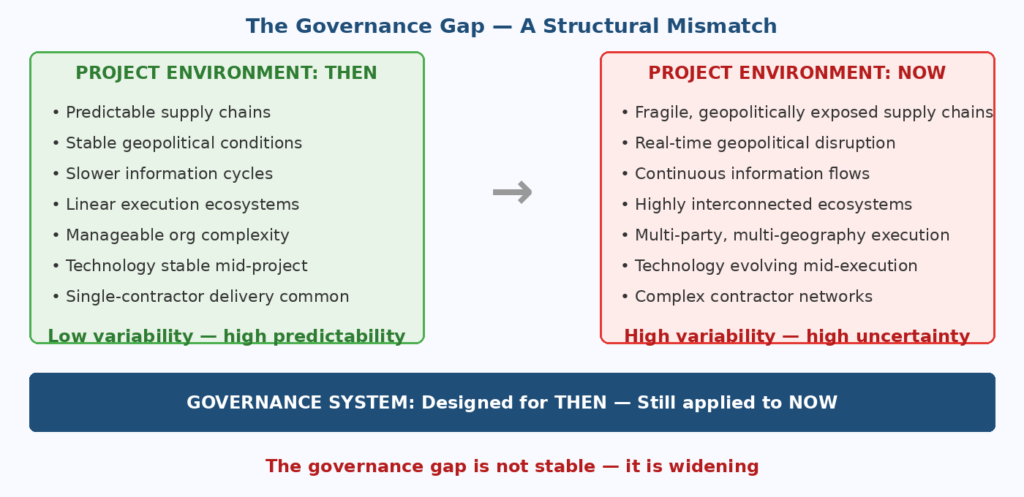
For organizations applying PPM, the governance gap has a specific and damaging character. PPM's value depends on production systems being designed with sound flow, variability management, and throughput logic, and then being controlled to behave as designed. Both conditions require a governance layer that can:
Traditional stage-gate governance cannot do this. It operates at a cadence that is a fraction of the speed at which modern project environments generate new risk conditions. The result is that even well-designed production systems are governed by a system that can only detect their deterioration after the damage has compounded. Decision velocity is strategic: the speed at which an organization identifies, escalates, and resolves emerging issues is a primary delivery capability. The governance layer must match that requirement.
The most damaging manifestation of this governance gap is cumulative drift, a pattern that is both endemic in major projects and structurally invisible to periodic governance systems. Individual engineering decisions, each below conventional escalation thresholds, aggregate into material erosion of the sanctioned economic basis and the production system's designed behavior. Weight additions increase lift complexity. Specification upgrades add fabrication interfaces. Redundancy growth alters installation sequencing. Each decision is defensible in isolation. Collectively they alter the production system's flow characteristics, variability profile, and throughput capacity, invisibly, until the aggregate consequence surfaces as a performance crisis.
Engineering decisions are economic decisions. Every design choice carries downstream cost and schedule consequence that compounds through the production system. A governance architecture that cannot connect those decisions to their economic implications in near-real time will systematically miss the drift that causes the most expensive project failures.
The cost-of-change curve makes this asymmetric and non-linear. Engineering changes caught in detailed design cost a fraction of the equivalent change during fabrication, and a small fraction of the same change discovered during offshore installation or commissioning. A governance system that cannot sense accumulating drift in near-real time is structurally exposed to the most expensive portion of this curve.
PPM and APDF address distinct but interdependent challenges. PPM answers two fundamental questions: How should this production system be designed to achieve the required throughput within acceptable variability? And how should it be controlled to behave as designed? These are questions of production system architecture and execution science, and PPM, grounded in Operations Science, provides rigorous and powerful answers.
APDF answers a different pair of questions: Is the production system currently behaving as designed? And when it begins to drift, who needs to know, with what information, at what velocity? These are questions of governance intelligence and organizational response, and they require a continuous sensing and adaptive escalation capability that conventional stage-gate governance was never designed to provide.
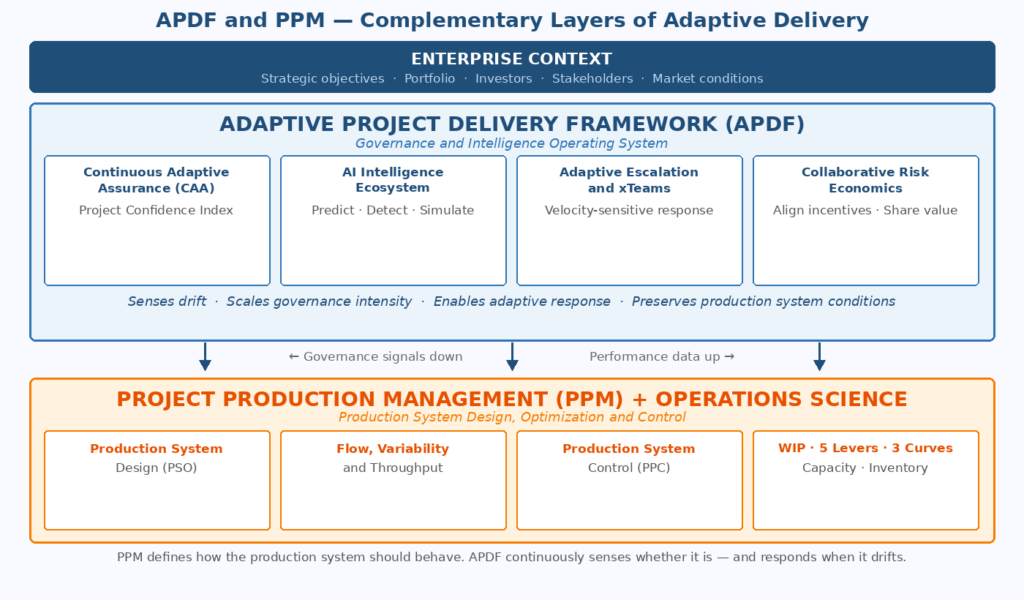
PPM defines how the project's production systems should behave. APDF continuously senses whether they are and activates the right response when they drift.
Figure 2 illustrates the layered relationship. PPM and Operations Science operate at the production system level, defining flow, managing variability, controlling WIP and throughput. APDF operates as the adaptive governance and intelligence layer above them, continuously ingesting the signals that production systems generate, synthesising them into a multi-dimensional health picture, and enabling governance intensity to scale dynamically with the conditions those systems are experiencing.
APDF integrates insights from five theoretical and applied domains, drawn from a broader set of nine that informed the framework's development. The five discussed below are those with the most direct bearing on the governance architecture; Table 1 maps each domain to its specific contribution and the APDF mechanism it informs.
| Domain | Core Contribution | APDF Mechanism |
|---|---|---|
| Complex Adaptive Systems [Holland 9, Stacey 10, Snowden 7] | Major projects exhibit emergence and non-linearity requiring sense-and-respond governance. The Cynefin framework operationalises this: complex domains require sensing and responding, not analysing and acting. | Continuous Adaptive Assurance; adaptive governance philosophy; Deterioration Rate Modifier |
| PPM + Operations Science [Zabelle 6, Flyvbjerg 15] | Projects as production systems: flow, variability, and throughput are the primary levers of delivery performance. Flyvbjerg's reference class forecasting demonstrates that outside-view, data-driven estimation consistently outperforms inside-view judgment, a principle that informs APDF's continuous, evidence-based confidence scoring. | Engineering drift detection; supply chain intelligence; PCI as outside-view health signal |
| Resilience Engineering [Hollnagel et al. 11] | Adaptive capacity, the ability to absorb disruption and recover, is more valuable in volatile environments than static efficiency. Resilient governance senses system state continuously and responds before capacity is exhausted. | Supply Chain Confidence domain; float management; Collaborative Risk Economics |
| Human-AI Collaboration [Cai et al. 12] | Effective human-AI partnership requires explainability and a clear task boundary. The AI handles cross-domain signal synthesis and pattern detection; humans retain authority over all consequential decisions. | AI Orchestration Model; human primacy design principle; structured decision pathways |
| Change Leadership [Kotter 13, Christensen 14] | Transformations require visible urgency signals grounded in data, not narrative (Kotter), and deployment strategies designed to work with institutional inertia rather than against it (Christensen). | Phased deployment model; PCI as urgency signal; evidence-first adoption sequencing |
The shared intellectual foundation between APDF and PPM explains why they work together naturally. Both treat projects as adaptive systems, not as linear plans. Both recognize that variability is a fundamental property of project environments that must be designed around, not ignored. Both reject the assumption that adding labor, oversight, or process intensity is an effective response to system underperformance. And both are grounded in the principle that continuous sensing and control produces better outcomes than periodic assessment and correction. Organizational friction is measurable delivery intelligence: the drag created by slow decisions and governance congestion can be quantified and managed, and both frameworks benefit when it is.
| PPM Principle | Governance Requirement | APDF Mechanism |
|---|---|---|
| Flow management: optimize throughput through production systems | Detect when engineering scope growth or interface complexity is degrading flow before it reaches the production floor | Engineering drift detection continuously connects design decisions to their flow and throughput consequences, because engineering decisions are economic decisions |
| Variability reduction: buffer and manage variability at the right points | Sense when supply chain disruption is compressing the buffers that production system design assumed, with enough lead time to adjust | Supply chain intelligence provides early warning of lead-time compression and vendor performance trajectories |
| WIP control: prevent congestion at constraint points | Identify when governance congestion is creating WIP at decision points: approvals queued, escalations aging, decisions delayed | Organizational friction monitoring quantifies governance WIP as measurable delivery intelligence |
| Production Control (PPC): control the system to behave as designed | Provide the signals that production control needs continuously. Governance must be predictive rather than retrospective to be of any use to a live production system | Continuous Adaptive Assurance replaces periodic reporting with a continuously updated multi-domain health picture |
| Continuous improvement: learn from system behavior | Capture what worked and what did not across projects, and apply learnings to calibrate future production system design and control | Enterprise Learning Layer logs outcomes and causal patterns across the project portfolio |
APDF represents a shift from control-centric project management to intelligence-enabled adaptive delivery. Three design principles define the architecture. The AI layer handles cross-domain signal synthesis, sub-threshold pattern detection across large data volumes, and scenario consequence modelling, where machine speed and breadth provide a genuine advantage. All escalation decisions, response pathway selection, and stakeholder commitments remain with human leaders, where judgment, accountability, and relationship are not substitutable. APDF integrates existing systems rather than replacing them: ERP, scheduling, engineering, and procurement systems remain the systems of record, connected into a coherent picture that none individually provides. And APDF replaces the right kind of governance with a more responsive kind: fewer standing committees, more purpose-formed rapid-response teams; less periodic reporting, more continuous intelligence.
APDF delivers five integrated capabilities. Detailed technical specifications for each capability have been developed by Basalt Consulting LLC; the conceptual framework is described below. A note on the Project Confidence Index (PCI): the framework operates across five domains, Delivery Confidence, Economic Confidence, Supply Chain Confidence, Organisational Confidence, and Engineering Drift, with a composite weighting (Delivery 30%, Economic 30%, Supply Chain 20%, Organisational 20%) derived from structured expert judgment and theoretical reasoning. A sixth domain, Governance Confidence, was identified during development as substantially duplicating Organisational Confidence; the genuinely distinct governance elements have been consolidated into the Organisational domain. This consolidation reflects a broader design principle: a framework whose purpose is to reduce governance friction should not incentivise governance activity as an end in itself. Empirical calibration of domain weights across project classes and phases is explicitly identified as a high-priority research requirement in Section 8.
The prototype walkthrough in Section 5 demonstrates the full APDF response cycle for the following scenario, one that recurs with damaging frequency in the IPA project failure dataset.
A USD 2.4 billion LNG facility expansion, the Pilbara Train 3 project, is in detailed engineering, 38% elapsed against a Q3 2027 target. The project is in Tier 2 governance with a PCI of 74, reflecting healthy cost and organisational performance but an emerging supply chain concern. A compressor vendor (KK-7, on the critical path) declares a 14-week fabrication delay citing force majeure. Under conventional governance, this event enters a risk register, triggers a schedule impact assessment over several weeks, and surfaces as a formal variance report at the next monthly review, by which point the decision window for the most economically advantageous response has narrowed significantly.
Under APDF, the Supply Chain Intelligence Agent detects the delivery breach and recalculates the PCI from 74 to 56 within minutes. Compound escalation rule SC-CRIT-02 fires, triggering an automatic Tier 3 escalation with a 72-hour decision window. Three structured response pathways with full economic consequence modelling are presented to the Project Director. The xTeam is activated and the decision audit trail begins. Selection of the recommended pathway and activation of an alternative vendor qualification occurs within 72 hours of the event, at a point where $28.3M of the $67.2M total exposure remains recoverable.
The capabilities described in Sections 4.1 through 4.3 address the governance and intelligence architecture of APDF within the execution phase of a major project. They represent the framework's most immediately deployable application. The original intent of APDF, and the most consequential claim the framework makes, is broader: that projects should be continuously assessed for competitiveness against their business case from concept development through delivery, not evaluated at discrete estimate milestones and assumed to be viable in between.
This section addresses that broader proposition and its most significant practical implication: the transformation of project estimating from a periodic batch process into a continuously updated real-time economic model.
The conventional estimating system, Class 5 through Class 2, with each class produced at a defined phase of project development, was designed to manage the uncertainty of early-phase projects. Early in a project's life, there is genuinely not enough definition to maintain a continuous cost model. Class 5 estimates carry accuracy ranges of -50% to +100% precisely because scope is not yet defined. Estimating classes exist to be honest about what is and is not known at each stage.
The problem lies in what happens after the Class 2 estimate is produced at end of FEED. At that point, the engineering basis is defined, the production system is designed, the major equipment lists are established, and the execution strategy is set. There is now enough definition to maintain a continuous economic model, but the industry does not. Instead, it treats the Class 2 estimate as a static sanctioned basis and updates it in batches: at the next scheduled cost report, at the next phase gate review, at the next quarterly estimate update. Each batch update aggregates weeks or months of engineering decisions, procurement commitments, and market movements into a single event that arrives as a surprise.
The surprise is not genuinely surprising. The signals were present throughout: in weight growth visible in the engineering model, in vendor quotes tracking above estimate allowances, in schedule float being consumed faster than planned. The batch estimating cycle does not create the problem; it simply ensures the problem is invisible until it has already compounded.
APDF eliminates the need for batch estimate updates after Class 2. The Class 2 estimate becomes the starting point for a living document that is current at all times.
APDF's Engineering-Economic Integration capability addresses this directly. The data fabric that connects engineering systems, procurement platforms, and scheduling tools to the intelligence layer does not merely generate governance signals: it maintains a continuously updated economic model. Every engineering change that alters material quantities flows immediately into the cost model. Every vendor quote accepted above the estimate allowance updates the committed cost picture. Every schedule slip that extends an offshore installation campaign recalculates the day-rate exposure.
The marginal value of APDF's continuous estimating capability over increased report frequency is the connection between individual decisions and their economic consequences at the point the decision is made, not when it is aggregated into the next report. A structural weight addition reviewed and approved in a discipline engineering meeting is connected to its offshore installation cost impact in real time, making that consequence visible to the engineer and the project manager at the moment when reversal is still possible, rather than weeks later when it has been superseded by fifty subsequent decisions.
The most commercially significant application of continuous economic assessment is the earlier identification of projects that have deteriorated past the point where recovery is economically rational. The current batch estimating system creates a structural bias toward continuation: when a deteriorating cost picture arrives at a quarterly estimate update, the project is already deep in detailed engineering or procurement, and the regret cost of stopping feels large relative to the projected cost of continuing. The sunk cost dynamic that Flyvbjerg identifies as endemic in major project decision-making [15] is an organizational and political dynamic that batch estimating inadvertently amplifies. By the time the estimate update reveals that the project's economics have deteriorated materially, the organization has committed fabrication contracts, mobilized execution teams, and generated a commercial momentum that makes stopping feel prohibitive.
A continuously updated economic model changes this dynamic fundamentally. When the economics deteriorate, the signal is visible in real time, before the organization has committed the fabrication contracts, before the offshore installation campaign has been mobilized, while the options of redirecting scope, redesigning the production system, or stopping the project are still genuinely available and economically manageable. For a portfolio of major capital projects, the value of making the kill decision one year earlier on a project that should be stopped is measured in the capital redeployed to projects with stronger competitive positions, the organizational capacity refocused, and the reputational cost of a later, larger failure avoided.
Stage gates serve two functions that are often conflated: they are information events, points at which the full project picture is assembled and assessed, and they are capital commitment events, points at which funds are released for the next phase. The batch estimating system makes these functions inseparable, because the gate is the only moment at which a complete, current cost picture is available.
APDF separates these functions. When the project's economic picture is continuously current, the stage gate loses its role as the primary information event. The information is already available, continuously, at any level of granularity required. What the gate retains is its capital commitment function. That function too can evolve: the vision APDF points toward is one in which funds are made available on a portfolio basis and drawn down by projects as long as their continuously assessed competitive position meets defined thresholds. The project's license to draw on capital is maintained continuously as long as the economics hold, and suspended or referred for executive review when they deteriorate past a defined trigger. The gate does not disappear, but it becomes a ratification event that confirms what the continuous model has already established, rather than a discovery event that reveals what the batch estimate has obscured.
It is important to distinguish the near-term deliverable from the longer-term implication. The near-term deliverable, a living estimate updated continuously post-Class 2, replacing batch estimate cycles with a real-time economic picture, is technically feasible with current capabilities and does not require any change to capital commitment governance. The longer-term implication, that stage gates may become ratification events rather than discovery events, and that capital authorization may eventually be conditioned on continuous competitive assessment rather than point-in-time estimates, requires years of demonstrated PCI predictive validity before any board or lender should accept it as a governance basis. The author is not proposing to abolish stage gates; the proposition is that as trust in continuous assessment is established over time through empirical validation, the information function of the gate becomes redundant while its capital commitment function is preserved and potentially enhanced. The governance frameworks, board accountability mechanisms, and financial controls that a continuous capital commitment model would eventually require present genuine open questions that the field needs to address.
The APDF framework has been implemented as a working prototype that demonstrates the five core capabilities operating as an integrated system. The prototype runs on a live AI intelligence engine and demonstrates the complete governance response cycle, from baseline monitoring through event detection, escalation, decision support, and recovery tracking, on the Pilbara Train 3 LNG scenario described in Section 4.3.
A note on scope: the prototype fully implements the Continuous Adaptive Assurance, Predictive Intelligence Ecosystem, and Adaptive Escalation capabilities, the first three of the five core capabilities. xTeam coordination and Collaborative Risk Economics are represented at the decision interface level. This reflects the current state of development; the full five-capability system is under active specification by Basalt Consulting LLC. The following four figures show the prototype at each stage of the governance response cycle. A live demonstration will be available at the symposium.
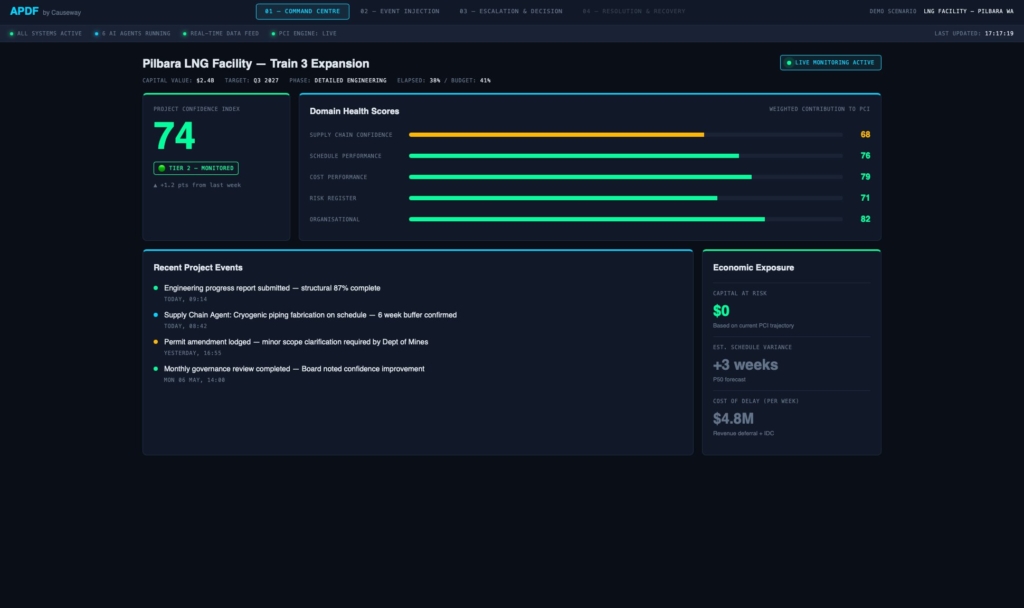
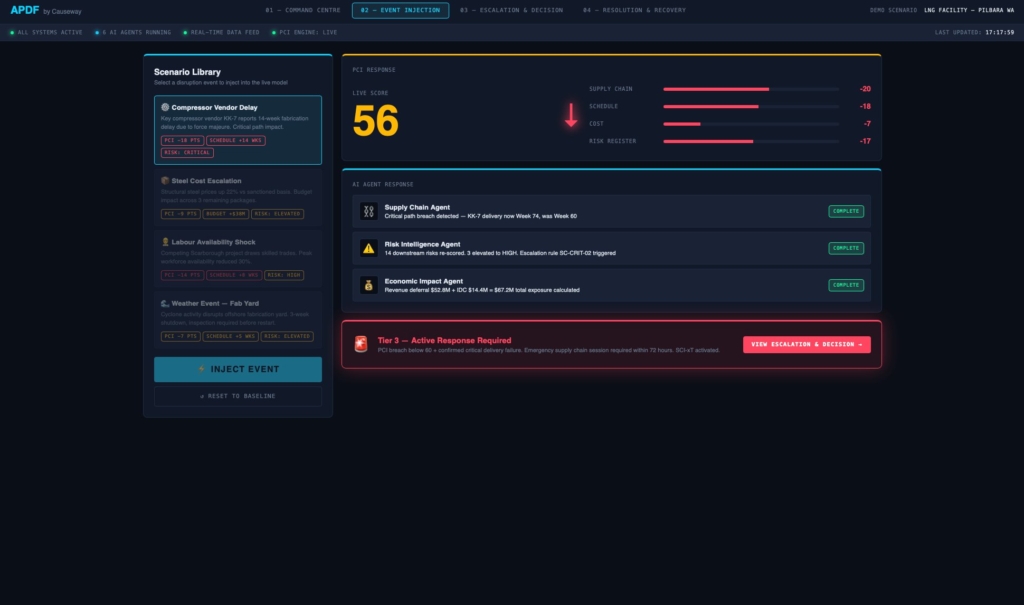
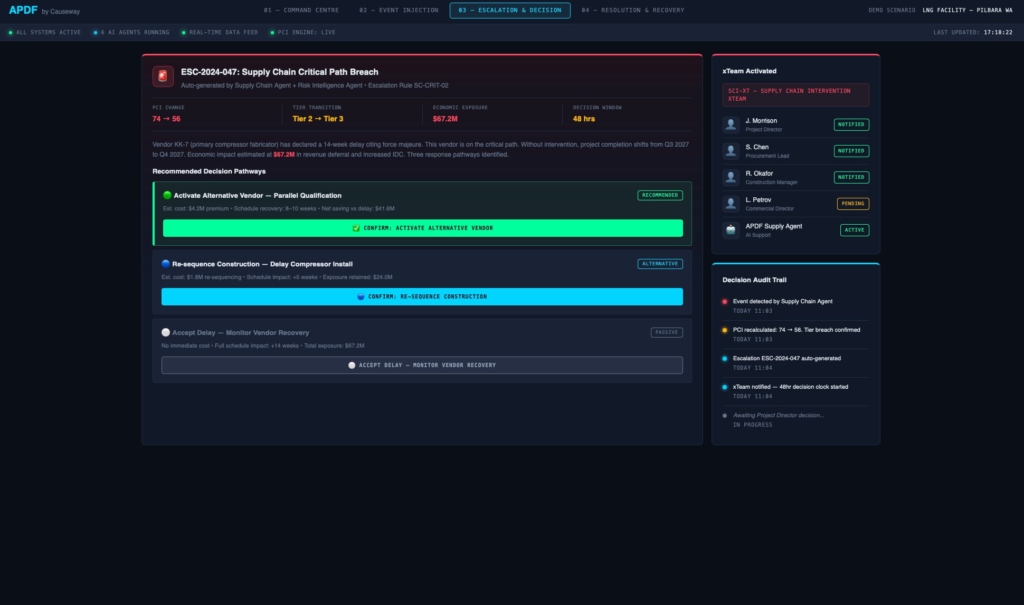
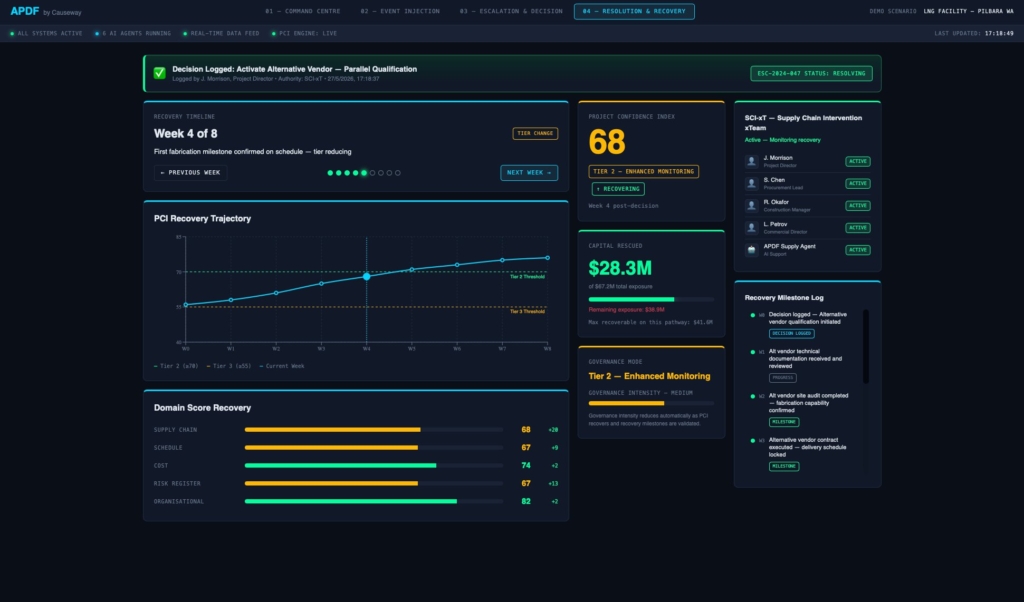
The four-stage walkthrough illustrates the intended interaction model of the APDF governance cycle: continuous baseline monitoring that detects the supply chain vulnerability before the crisis arrives; real-time multi-agent consequence synthesis that compresses weeks of conventional assessment into minutes; structured decision support that presents the Project Director with three evidentially grounded pathways and a 72-hour decision window; and governed recovery tracking that reduces governance intensity automatically as the PCI recovers. The Pilbara scenario is a designed demonstration of the intended framework behavior, not an empirical data collection exercise; the figures cited, $28.3M recovered, 72-hour decision window, PCI recovery trajectory, represent the framework's intended operating parameters, and their empirical validation in live deployments is the subject of the research agenda in Section 7.
APDF's economic model identifies five distinct value levers, each grounded in first-principles mechanisms traceable to specific framework capabilities. The model is calibrated against a reference project, a USD 2 billion offshore oil and gas development at Tier 2 complexity. Sector adjustment factors have been developed for infrastructure, nuclear, mining, and renewable energy contexts. The model is presented explicitly as a first-principles value hypothesis: the derivation logic is sound and the assumptions are grounded in industry benchmark data, but the model has not been validated against live APDF deployment outcomes. Empirical validation is the highest-priority item on the research agenda described in Section 8.
| Value Lever | Mechanism | Conservative | Base Case |
|---|---|---|---|
| G-1: Engineering Escalation Prevention | Earlier detection of accumulating engineering drift intercepts changes before the most expensive portion of the cost-of-change curve | $13.4M | $27.0M |
| G-2: Intervention Timing Improvement | Predictive governance enables intervention before deterioration becomes crisis, reducing mitigation cost across all production system domains | $17.6M | $36.0M |
| G-3: Contingency Efficiency | Collaborative Risk Economics reduces the adversarial contingency premium and improves contingency utilisation efficiency | $7.2M | $15.0M |
| G-4: Decision Velocity Improvement | Reduced organisational friction compresses issue-to-resolution cycle times, converting governance latency, which is measurable delivery intelligence, into a direct economic benefit | $5.6M | $18.6M |
| G-5: Schedule Resilience | Earlier supply chain intervention, proactive float management, and critical path protection reduce the frequency and severity of schedule-impacting events | $8.3M | $26.3M |
| TOTAL (ex. production revenue recovery) | First-principles value hypothesis. USD 2B offshore O&G, Tier 2 complexity, full Phase 1-4 deployment | $52.1M (2.6% CAPEX) | $122.9M (6.1% CAPEX) |
The modelled savings of 2.6-6.1% of sanctioned CAPEX are deliberately conservative. Industry benchmarks consistently document average cost overruns of 20-30% of sanctioned value. The five value levers modelled here target only a specific subset of that overrun: the portion most directly attributable to governance latency, sub-threshold drift accumulation, and adversarial commercial dynamics. The marginal value of APDF over simply increasing governance frequency lies in machine-speed cross-domain synthesis: APDF detects compound, sub-threshold signals simultaneously across supply chain, engineering, schedule, organisational, and economic domains at a speed and breadth that human review at any cadence cannot replicate.
Illustrative derivation, G-2 (Intervention Timing Improvement): IPA benchmarking establishes that the average cost of a major project deterioration event (schedule slip or cost variance exceeding 5% of sanction) is approximately 8-12% of affected project value when detected at fabrication stage versus 2-4% when detected during detailed engineering. On a USD 2B reference project, assuming 4 material events over the project lifecycle, average affected value $200M per event, and timing improvement from fabrication to engineering-stage detection: (8% - 3%) x $200M x 4 events x 0.5 conservatism discount = $20M, rounding to $17.6M conservative. All five levers follow analogous derivation logic grounded in IPA, McKinsey, and KPMG benchmark data. The full derivation workbook is available from the author on request.
A sixth value lever, real-time competitive assessment and the earlier kill or redirect of projects whose economics have deteriorated past recovery, is not included in the quantified model above because its magnitude is highly portfolio-specific. It is noted here as potentially the largest single source of value in the framework: the avoided sunk cost and redeployed capital from stopping a fundamentally uncompetitive project twelve months earlier than a batch estimating cycle would have surfaced the signal is, for most portfolios, larger than the sum of the five levers modelled. This is offered as a hypothesis for empirical investigation, not a quantified claim.
Production revenue recovery from schedule improvement is excluded from Table 3 as highly project-specific. For a facility at prevailing LNG prices, each week of earlier first production represents a revenue impact that substantially exceeds the direct cost savings modelled, strengthening the economic case materially.
APDF is an organizational transformation, not a technology deployment. The author's experience developing this framework through the AI for Senior Leaders programme at MIT xPRO confirmed a conclusion consistent with its design: the fundamental challenge is not technology adoption but redefining decision authority in environments where information changes faster than governance structures can respond. Technology layered onto existing governance without redefining decision rights will amplify existing bottlenecks and erode trust.
APDF's deployment is structured as four sequential phases, Visibility Integration, Predictive Intelligence, Adaptive Governance, and Enterprise Orchestration, explicitly designed to build organizational confidence before asking for governance authority. The first phases deliver observable value through unified data access and early warning capability. The evidence they generate creates the buy-in that later phases require. This sequencing reflects a deliberate change management strategy: demonstrating value at each phase before requiring the decision rights redistribution that the next phase depends on [8].
A candid note on Phase 1 timelines: the 0-6 month Visibility Integration horizon assumes that ERP, scheduling, and procurement systems are accessible and that a data steward can be appointed to each source. In practice, large projects with fragmented contractor ecosystems, where cost, schedule, and engineering data are managed by different organizations on different platforms with different reporting cadences, may require 12-18 months to achieve the data completeness thresholds on which agent intelligence depends. This is a reflection of the data quality debt that most major projects carry, not a failure of the framework. APDF's Phase 1 deployment plan should be scoped honestly against the project's actual data landscape, not against an idealised integration baseline. The framework's value proposition does not change in lower-data-quality environments, but the timeline to realising it does, and organizations should plan accordingly.
Kotter's research on change leadership [13] identifies failure to create sufficient urgency and failure to anchor change in culture as the most common reasons transformations stall. The Project Confidence Index addresses both directly: it creates a continuous, visible urgency signal grounded in real project data rather than narrative, and the phased deployment model embeds new governance behaviours incrementally rather than requiring a simultaneous cultural shift. Christensen's work on disruptive innovation [14] offers a complementary lens: organizations that have built governance competency around stage-gate control have significant institutional investment in that model. The APDF deployment approach is designed to work with this institutional inertia, by making the value of adaptive governance demonstrably visible before asking the organization to relinquish the governance structures it has built.
Future advantage belongs to adaptive enterprises, organizations that can sense, respond, and learn faster than their project environments generate new complexity. That capability requires leaders who are willing to reorient from reactive oversight to adaptive, data-driven decision-making: distributing decision rights to teams operating within defined thresholds, measuring performance based on decision velocity and responsiveness rather than process compliance, and modelling the collaborative, intelligence-informed behaviours that APDF depends on. The organizations that build this capability will not merely perform better on individual projects; they will develop the institutional adaptive capacity that represents a durable source of competitive advantage, continuously underwriting project competitiveness through every phase of delivery.
APDF's development has surfaced a set of genuine empirical gaps where the framework currently rests on theoretical reasoning and industry benchmarks rather than validated evidence. The prototype walkthrough in Section 5 illustrates what these variables look like in practice, making the research questions concrete and their measurement design tractable, but the scenario is a designed demonstration of intended behavior, not an empirical data collection exercise. The questions below represent the programme of validation work that live deployments must address.
The author would be happy to discuss any of these questions with interested colleagues and to explore whether collaborative work in any of these areas might be of mutual value.
The major capital project delivery industry faces a widening structural problem: governance systems designed for a more stable era are being applied to project environments of increasing volatility, interdependency, and complexity. For organizations that have invested in Project Production Management, this problem has a specific character: the production systems they design with care are governed by systems that cannot sense their drift in time to preserve the flow conditions, variability buffers, and throughput trajectories those designs depend on.
APDF represents a shift from control-centric project management to intelligence-enabled adaptive delivery. The framework is a governance and intelligence operating layer that enables PPM to perform as designed in the environments that modern major projects actually face. Projects are adaptive systems, and the organizations that govern them must be too. Governance must become predictive rather than retrospective. Organizational friction must be treated as measurable delivery intelligence. Decision velocity must be recognized as strategic. AI must augment leadership, amplifying human judgment rather than substituting for it.
PPM tells you how your production system should behave. APDF makes sure you know when it is not, and ensures the right people respond, with the right information, at the right speed. Predictability comes from adaptability.
The proposition introduced in Section 4.4 goes further: that continuous economic intelligence, enabled by APDF, has the potential to transform not only how projects are governed but how capital is committed to them, replacing the batch estimate and the stage gate as the primary mechanisms of project oversight with a continuously updated competitive assessment that reflects what is actually happening on the project, in the supply chain, and in the market. Its validation requires the kind of collaborative engagement between practitioners, researchers, and governance bodies that a symposium such as this exists to enable. Future advantage belongs to adaptive enterprises, those that develop the organizational capability to operate at the speed that modern capital project environments demand. The author would be happy to collaborate with colleagues interested in advancing any aspect of this work.