
Strategic Project Solutions, Inc.


Roberto Arbulu presents five minimum requirements for effective data center supply chains, showing how lead time analysis, transparency systems, redundancy strategies, and production system thinking can close the gap between construction capability and the one-year technology refresh cycle driving demand.
Great performance on data center projects is directly tied to the effectiveness of supply chains, yet the industry consistently underestimates the complexity and dynamics of the systems it depends on. With lead times stretching to 600 days for generators and 87 weeks for critical equipment, and with technology refreshing on a one-year rhythm while construction timelines lag far behind, the gap between what owners need and what the industry can deliver has become a critical constraint.
The industry must move from purchasing transactions to production system thinking. Without understanding supply chains as interconnected systems rather than line items on a PO, no amount of technology will close the gap between what data center owners need and what construction can deliver.
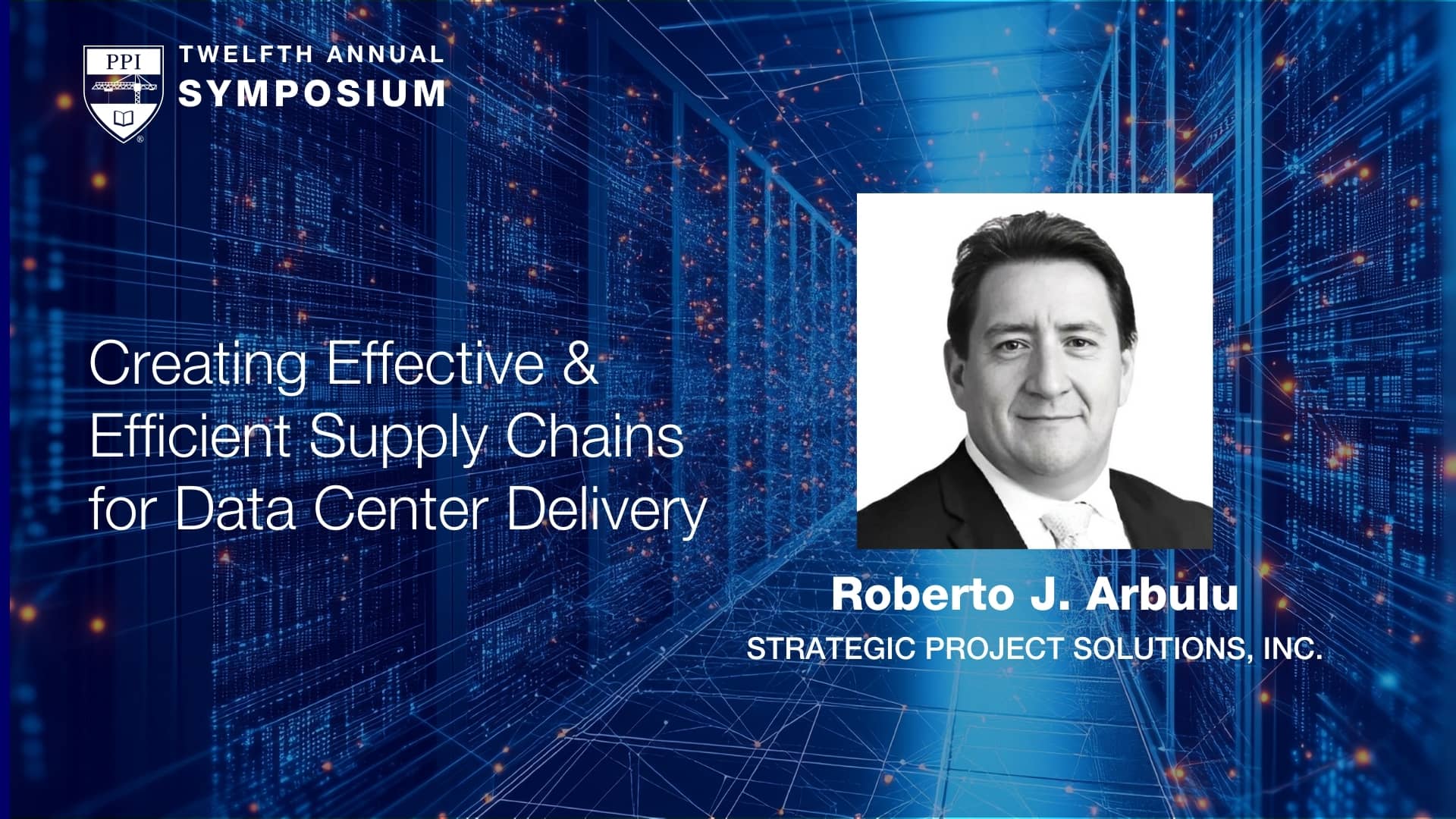
[00:00:00] Gary Fischer, PE: So now we’re ready to move on to our next presentation. All around effective management of supply chains for data centers, which is just absolutely vital in today’s world. So we have Ro, Roberto, ar. Of strategic project solutions to share some wisdom on how to do that. Roberto is the Senior Vice President of Technical Services for Strategic Project Solutions.
[00:00:27] Gary Fischer, PE: He’s got more than 25 years of experience in delivery and optimization of energy, industrial technology and infrastructure capital projects. Work with numerous owner and operators, service providers around the globe. We couldn’t be in better hands here for this presentation. And again, if you get questions, drop ’em into chat.
[00:00:45] Gary Fischer, PE: Drop ’em into the q and a. This should be good, Roberto. Thank you,
[00:00:49] Roberto J. Arbulu: Gary.
[00:00:50] Gary Fischer, PE: I can see your, I can see your slides.
[00:00:53] Roberto J. Arbulu: Excellent. Can you hear me well? Yep. Excellent. So thank you so much. Look coincidentally I’m actually connecting from a data center construction site. So it is very interesting to see how the idea of an importance of supply chains for data centers actually come to play.
[00:01:14] Roberto J. Arbulu: I think my objective today is to share with you I would say. Not only a strategic perspective of what organizations can do when it comes to supply chains, but also get tactical, right? And when we get tactical, we are gonna see some examples of what others are doing in the industry to improve the way they approach supply chains.
[00:01:38] Roberto J. Arbulu: I think there’s a little bit of everything for owners to contractors, to suppliers in, I think the messages that we, bring today. But I think it’s important that we recognize very openly that great performance achieving the outcomes that we want are very related to the effectiveness and efficiency of our supply chains.
[00:02:06] Roberto J. Arbulu: There’s no doubt about that, right? We made a mistake on how we synchronize flows of materials, our equipment, permanent equipment. We know what the repulse effects are going to be. However, I don’t think personally, and this is just based on my experience, that sometimes we truly understand the inherent complexity and dynamics of the supply chains that we interact with.
[00:02:34] Roberto J. Arbulu: Okay. Equipment, materials modules, anything you can think of. Okay. This is just an example of one data center not in the u, not in the US and the uk, where with just some of the, what the industry recognized as OFCI, equipment owner, furnish contract contractor install equipment. And just by looking at the schematic, you can see the complexity of just on that equipment.
[00:03:05] Roberto J. Arbulu: This is not even taking account. Construction materials, right? Where do, where stuff come from, right? What are the dynamics, right? Do we need to go to customs? And this is from different type of materials and sorry, equipment that is typically used in, data centers. I think that to understand complexity, you have to expose it first.
[00:03:33] Roberto J. Arbulu: Complexity is not going to expose itself by an act of magic, and I think we need to do a lot of work in our industry to get to understanding first that complexity. But when we mix it, when the complexity of our supply flows and supply chains, it’s mixed with the objective that we have on site and how we install things and how.
[00:04:02] Roberto J. Arbulu: Synchronized. These supply chains need to be right. We get things like this, okay? This is an schematic that shows different points in time during construction of multiple colors and all these materials coming from the same supply pool, but they need to arrive at a very specific timeframes. So it’s a very complex network that we are all in our industry.
[00:04:29] Roberto J. Arbulu: In front of that, we need to find better ways on how to handle this. But if we even take it beyond just one data center, and we look at supply, which is the intent of showing this part of the schematic on the left, that we have the same supply base, sending equipment materials to multiple data center.
[00:04:52] Roberto J. Arbulu: We get data centers, we get into more like a deployment type. Perspective on this. Okay? So if, you are an owner and, you own these data centers and you are managing OFCI equipment, this is your reality. Okay? If you’re a contractor and you’re working on multiple data centers at the same time especially these days with demand increasing quite significantly, right?
[00:05:19] Roberto J. Arbulu: And you also work with the same. Supply based, you will not end up with this sort of situation. Okay, so repeat I, don’t think personally that we fully, as an industry fully understand the complexity and the dynamics of supply chains. Let’s just start getting a bit deeper on what do we mean by efficient and effective supply chains?
[00:05:44] Roberto J. Arbulu: Okay. And it’s important that we start with defining. Proposing to you suggesting a definition of what supply chains are in projects and they’re really the concept of systems, it mentioned that, but it’s really an interconnected production and inventory systems that provide needed materials and services to the project.
[00:06:10] Roberto J. Arbulu: So if you are an owner, once again, the construction companies. The engineering companies are actively part of your supply chain. It’s not just about material, right? But the key message here is this idea of systems, right? But unfortunately the way the industry operates is more on the left of this this slide here, right?
[00:06:34] Roberto J. Arbulu: Where we are looking at just transactions and we’re focusing quite significantly on purchasing, right? Understanding. I repeat. How complex and dynamic the supply flows and supply chains are. A lot of people are focusing on trying to build relationships, which is not bad. The question is that enough?
[00:06:58] Roberto J. Arbulu: But if we really talking about true supply chain, we will have to get into the world of production systems. And I think that is the main message, right? Where are you, whoever you are that are, listening, where are you in this spectrum? Okay. And that actually relates to mentioned something that Todd mentioned earlier in his presentation about the concept of administration and product.
[00:07:27] Roberto J. Arbulu: So I think that if we are truly committed to optimize our supply chains, we need to focus on, we need to move from administration to production. I’m going to introduce. What we think are the minimum requirements for an effective supply chain. And this is, again, strategic and a bit tactical at the same time with some examples.
[00:07:55] Roberto J. Arbulu: Okay? But let me introduce what we think are these key requirements. So first of all, we need supply chains that are reliable, transparent. We need to have some redundancy. In the supply system, we want them to be flexible. We wanna have the opportunity to change things because our business is asking, is requiring that we make some adjustments, sometimes need to go faster.
[00:08:21] Roberto J. Arbulu: So agility and flexibility to, to, change things in the supply. It’s quite important. Very critical. Cost efficient, no doubt about it. And every one of these. Has a specific idea behind it, which I will take you through that in a second. So let’s just start with reliability, right?
[00:08:42] Roberto J. Arbulu: Reliability of supply. I wanna bring an idea that is coming from other industries, not the engineering and construction industry. On manufacturing. Could be one for instance. Which is the idea of having a supplier development program, right? Where owners, contractors, in this case and suppliers will work collectively to actually improve and, the performance of supply, right?
[00:09:11] Roberto J. Arbulu: Not only looking at technical, but also checking that the supply chain does have the capacity, obviously to meet certain demand. But in these cases, supply programs, which are very powerful among a lot of things we propose to, you should focus on at a minimum three things, right? Being able to concurrently look at product and process design.
[00:09:38] Roberto J. Arbulu: I think we got examples from, Ed and examples comments also from in the previous presentation. This is very important. The ability to concurrently right, and influence how we’re gonna make things according to a specific objective, right? A lot of people in industry, in the data center industry are looking for speed.
[00:10:01] Roberto J. Arbulu: Everyone knows that, and so speed to market is very critical. But if we get engineering or design of data centers that are not allowing us to do that we also have some constraints on, the, how we can build it to go faster, right? A lot of organizations are looking for fungibility of components and things in the delivery of data centers.
[00:10:27] Roberto J. Arbulu: The second one is we need to do. Something beyond current practice to reduce lead times. I’ll show an example in a minute on this and no, no doubt about quality, right? Quality, especially in data centers is paramount. And we do not need to ignore quality or safety, but it’s all connected, right?
[00:10:52] Roberto J. Arbulu: One thing I wanted to highlight in the context of understanding complexity and also the idea of lead times is that it is very difficult to get to optimized supply without understanding what types of supply we have and what we deal with. And so I’m gonna bring some very simple schematics here for you.
[00:11:19] Roberto J. Arbulu: If you have not seen this or not aware of some of these terminologies, some of the stuff that we buy that we need, I should say in, in, in the engineer and construction of data centers is made to stock items, right? Commodities to some extent. Things that are suppliers will typically keep it in stock and we just need to basically get it from those stocks and the lead in these cases, typically short as long as that stock exists.
[00:11:49] Roberto J. Arbulu: If you have even commodity or standard items that are not special, but they come from a different country, perhaps these lead times might get extended just because they need to go through customs and it takes a bit of longer time. Another type is when things become really made to order, right?
[00:12:06] Roberto J. Arbulu: The supplier of something or equipment or, materials, don’t typically keep stock of these items. And so you as the person that needs, that will have to wait longer be, or you have to wait for them to make it for you. So that inventory at the end of delivery or fabrication, excuse me, does not exist, right?
[00:12:30] Roberto J. Arbulu: So the lead times start getting longer. If we take it to the next level, we’re talking about engineer to order items, which is one of the most common ones in, engineering and construction, including data centers. Where we need to wait for the engineering is a special item and we need to delete.
[00:12:50] Roberto J. Arbulu: Time will get extended because the engineering is, it’s something we need to do. Okay? And so we cannot handle the dynamics and optimization of supply of each of these the same way. They don’t behave the same way. Okay? We cannot apply necessarily the same recipe to each of these types. So we need to start with that understanding.
[00:13:15] Roberto J. Arbulu: Now, in terms of lead times, and that’s why I was showing the previous framework, these are actually real examples. These are lead times that are companies for data centers quoting. Generators, everyone knows. Also, switch gear is another one, but we have liens that are actually 600 days. This is two years more than that.
[00:13:37] Roberto J. Arbulu: 87 weeks for generators, right? We have. The more we move into a skiing like in this case WCC means water fuller tillers, right? The more we go into these modules, the lead time will get extended. Okay? And a series of them. Okay? So, the lead times that we need to deal with are not short, and that generates a lot of issues because that means that we need to release money.
[00:14:05] Roberto J. Arbulu: Depends on who is the person that needs. The material release money has huge implications on cash flow. Okay? And also, there are other implications associated with our ability to synchronize that supply. And we end up with, in many cases, significant volume of unnecessary inventories in our construction sites.
[00:14:28] Roberto J. Arbulu: So one idea, in order to be reliable, we must focus on minimizing, reducing the lead times. Okay, now a big technical here but, also a simple concept, which is the, lead time in many cases is really a promise, right? It is a promise that suppliers make. And honestly, the more we work with, suppliers and different companies, there’s nothing really scientific about the definition of a lead time.
[00:14:57] Roberto J. Arbulu: The lead time is really that promise, but when we get to cycle time. Actual time that it takes to make something. It’s not uncommon to see this sort of proportion, right when the time I am given takes pretty long time, but what it really takes to do something is it’s much shorter. Okay? Now I’m not the only.
[00:15:23] Roberto J. Arbulu: Customer of a supplier. Obviously supplier has more and they’re probably balancing their capacity. But even though this gap that you see here between Li time and cycle time is I think a huge opportunity for us in the industry. And this example will show once again, a bit more tactical, getting down into what this is about.
[00:15:46] Roberto J. Arbulu: This is an example of skits, the water cooler. Cool chill skits. This is a piece of work that was done with, actually the same supplier and the owner that was involved in this analysis. The supplier quoted about 44 weeks total, including some of the development of engineering and approval, the need to be made.
[00:16:08] Roberto J. Arbulu: And as we were getting deeper there’s actually. A deeper schematic on this. I trying to summarize it for us and our audience today. But we can see immediately that the compressors here taking eight to 12 weeks are certainly an issue if we want to compress the total cycle time. Not only that, but also the engineering and the approval process.
[00:16:33] Roberto J. Arbulu: And there are huge opportunities. Okay. Not a little, huge opportunities. In, supply chain management, in supply chain for data centers. They’re in front of us, but I don’t think we have necessarily, everyone has the tools and, let’s say almost like the special goggles to see where these opportunities are.
[00:16:59] Roberto J. Arbulu: Okay. Below you can see that from what the supplier quoted all the way to the time it takes without doing the factory acceptance test. We’re talking about almost half half of that lead time that was quoted on paper. And there’s probably more opportunities for improvement. So we wanna be reliable.
[00:17:22] Roberto J. Arbulu: Yes. Liens are not helping us. And another action that companies are taking. Remember, we’re still in the first minimal requirement. Another action that companies are taking is to systematically understand the processes on how, what they need the supply processes, okay? And start creating libraries of these supply processes.
[00:17:51] Roberto J. Arbulu: And this is independently, if they. Have they don’t own that business, right? They need to understand them in order to see what the implications are and what the, critical component. So the idea of a standard process is not only standard products, okay? Not only making making the, building design standard also critical in the idea of becoming more reliable.
[00:18:16] Roberto J. Arbulu: That would allow us to put some measurements, right? And these measurements are critical as well, because. They will make us understand what is taking to do things versus the initial targets, right? This is example, all this is data centered, by the way. These are real example from real data centers that we have had the chance to be part of.
[00:18:39] Roberto J. Arbulu: And if you look at the middle right to put a po, then star manufacturing ready to ship and receive on the job. Some people call it ROJ dates. Some people call it ROS, require site independently or how you call it. The message here is that we can systematically control and measure how reliable these supplies are.
[00:19:00] Roberto J. Arbulu: Also, how much time it takes. So the chart below on the left is air handling units, multiple different types. And we can check how much time is really taking us and if we are actively compressing that time compared to the lead time so we can make the synchronization of our supply chains better example on the right is more about generator generators.
[00:19:22] Roberto J. Arbulu: So companies are systematically measuring this. And, looking at the behavior of the systems, right? Not only the manufacturing, but also what happens when the moment we place a po Okay. Which we need to do commercially, obviously until the moment we start making something. And as you can see here, there’s a significant range between 75 days and 185 days.
[00:19:46] Roberto J. Arbulu: A lot of time before we even start making something. It’s because we do a lot of engineering, right? The items that we are dealing with are unique, right? They’re not in stock and we need to make them from scratch. We need to engineer them, right? And so gaining, reliability in the system is important that we also put some measurements, like cycle times on top.
[00:20:09] Roberto J. Arbulu: This is also very interesting data. Also from data centers that. In collaboration with multiple suppliers, building multiple data centers in the United States, an owner basically over a period of time. This is from 2018 to 2021, as you can see was actually looking at what happened with the production.
[00:20:36] Roberto J. Arbulu: Either knowledge production or craft production in the supply flows. And what was the, reliability of that system, and what were the reasons why the the supply actually stopped, right? People were not having previous work. They needed engineering or actually physical work and a series of categories.
[00:20:59] Roberto J. Arbulu: Okay? And so we wanna be reliable. I guess the question is. Can we measure it? Of course we can, but we need to put a system in place and structure a framework, an approach, a methodology in order to do it systematically. Let me move into the second idea that I bring to you guys today on transparency, right?
[00:21:20] Roberto J. Arbulu: We need to be able to understand where things are at any given time and if deliveries are arriving too early or they’re arriving late. If they’re running late, out late as part of what we propose to use a requirement on effective and efficient supply chains, this is also an example of a data center company that is using our technology to look at multiple supply of supply flows of equipment every single block.
[00:21:58] Roberto J. Arbulu: That you see here, square, that you see here rectangle, excuse me, is it’s a ma it is a, it’s a piece of equipment that is traveling through the traveling through the system, the supply system, right? And as you can see on the triangles, on the boxes, if you see one in the triangles, that means that it’s waiting, right?
[00:22:18] Roberto J. Arbulu: And it’s happening a lot, right? And it’s waiting for a reason. And so, the first step on transparency is to understand. How we see our supply network, it’s just almost like a, control tower in an airport you can see the planes landing, right? And either delays, what are we gonna do? Okay? It’s the same concept.
[00:22:38] Roberto J. Arbulu: But these days with technology, we can actually use iot Internet of things to automatically connect our supply flows and get that same view. And understand how the supply flows behave. Okay? Less human intervention. More, automation. And I think iot is helping us to do that connection, but we need a platform that allows us to see, and our customers are using our own platform for that purpose.
[00:23:06] Roberto J. Arbulu: The third requirement is redundancy. We all know that. In the world of supply data centers is not an exception in general, right? We do by have we do expect disruptions in, different types and ways, right? There also changes in the demand, right? And many other sources. So, the question is what are the key ideas about redundancy, right?
[00:23:39] Roberto J. Arbulu: We see in all industries, I just bring this simple idea. Manufacturing. Toyota used to do this or having two key suppliers. And it’s not that really complicated as long as we systematically understand the companies that we wanna work with. Okay. And when I say wanna work with, work with Right.
[00:23:57] Roberto J. Arbulu: Getting into the details and maintaining these suppliers with us for the journey. Especially when we have companies with large data center programs where there’s a significant amount of repetition. Okay. Another technique or strategy more than a technique, excuse me is buying capacity, right?
[00:24:17] Roberto J. Arbulu: Rather than buying an item or a number of items or equipment or skit, is to buy certain percentage of the production capacity in a facility. Okay, because I have obviously a program, right? Multiple data centers, right? And we can use that capacity as we deem appropriate right? When we need to. And there’s a series, the whole world on, on, on how buying capacity can be effectively done.
[00:24:45] Roberto J. Arbulu: So I just bring that idea. For those of you who are not aware of, it’s very very important that if you have the opportunity, this is perhaps better than maintaining inventories. Okay? And another one is the concept of pressure testing the system. Any production system has limited capacity, okay?
[00:25:07] Roberto J. Arbulu: There’s no single production system without it. But the question is, do we understand that limited capacity? These days with the use of technology, we do have opportunities to map that supply system. Okay? And this has to be done in collaboration with one or multiple suppliers. This is an example of.
[00:25:29] Roberto J. Arbulu: Actually modular electrical rooms known in the industry like AMRs, right? And this supplier this customer, this owner said, look, I can see my demand is gonna increase. I’m gonna, I’m gonna impose a demand twice the size of what my supplier has been able to give me so far. I wanna work with the supplier and understand can they do it, can they keep up?
[00:25:56] Roberto J. Arbulu: So what we did is we created a, production system model. And we tested, we put pressure on that model, if you will, virtually right, and determined that certainly it gets to a point, for instance, at one point. Five times the demand that the system will require 60% more capacity. So the supplier certainly will be taken to an extreme in terms of the capacity.
[00:26:22] Roberto J. Arbulu: And there are two options there. One is they invest a bit more on production facilities or you have to work with someone else because they don’t have the capacity to do it. Rather than just a conversation on a meeting room, we do an analysis on what will it take to, to deliver a certain amount of demand.
[00:26:43] Roberto J. Arbulu: And also the, capacity utilization in the system they can see in this chart below and the profile of the capacity utilization will change quite significantly. Okay. And this is these are things that are other, companies are doing systematically these days. The fourth requirement, and I wanna start moving a bit faster here, knowing that conscious of time, the other requirement is the idea of being flexible and agile.
[00:27:13] Roberto J. Arbulu: Now you might think yeah, everyone knows that. But I think what is happening in the market is in, in, the world of data centers and technologies, something quite significant. And I took this from Nvidia and I’m sure you guys have been watching. A lot of presentations not only from Nvidia, but other other organizations in the market that are heavily involved in data centers.
[00:27:37] Roberto J. Arbulu: But I wanna bring to your attention the comment below, one year rhythm every year, new technology. As I said at the beginning of my presentation I happened to be on a, data center construction site this week. And I was talking to a superintendent yesterday. We were talking about this in a very informal way, and superintendent said, look lemme tell you something.
[00:28:07] Roberto J. Arbulu: I was on my previous data center I have been doing data center for the last 10 years. He said, on my previous data center we were building it, finishing the construction, and at the same time we were refurbishing it. Because the technology that the data center was designed on was, actually obsolete.
[00:28:27] Roberto J. Arbulu: We needed to have different supporting systems, right? And so what we’re dealing with is the construction industry is not capable, right? The this is globally. This is not just in the us it’s not capable OB supporting the speed which those that will run these data centers actually need. Okay? And it’s becoming a constraint, a significant constraint.
[00:28:52] Roberto J. Arbulu: For, technology company, for owners to be able to move faster without compromising quality. Without compromising safety. Okay? And so how do we deal with that problem? And supply is critical on this. And that’s why we are focusing on these five minimum requirements. Not the only ones, but the minimum requirements with you today.
[00:29:17] Roberto J. Arbulu: I wanted to bring these photos and the ones on the top are not data center related but are more across industry because my message here is also the whole industry, not just data centers. The ones below are data centers. And this is what we see, right? We, I took all these photos, nobody’s sending them to me.
[00:29:36] Roberto J. Arbulu: I didn’t download from the internet. I took them myself. Okay, and this is the way we operate. On the top, you have a lot of pipe spools, some of them very dirty, right? And below you have warehouses with a lot of equipment from mechanical, electrical generators and modules that are for one single project, okay?
[00:29:59] Roberto J. Arbulu: These are no warehouses for 10 projects. No, this is for one single project, right? And so there’s no way we can achieve time to market. We can achieve flexibility, we can achieve fungibility. If we operate this way, we need to do something with our supply chains in projects. And this has to change.
[00:30:23] Roberto J. Arbulu: But the key ideas here are if we have excessive inventory, we should find it and we should minimize it. And we should understand what creates that excessive inventory. Why are we just. People, we always say people prefer to look at it than looking for it, right? Some people say, look, if I miss the deadline, it’s gonna have a huge ripple effect in my ability to finish the data center on time, which is true, right?
[00:30:50] Roberto J. Arbulu: But we’re not saying, we’re not saying zero inventory. We’re saying, okay, what is the optimal amount of inventory, right? And how can we work with our supply chain to the other idea is buffering. We know that the supply chains will experience variability. No doubt about it. Variability cannot be fully eliminated, and so we can use capacity, we can use some of that inventory, and the idea also where to use it.
[00:31:16] Roberto J. Arbulu: Where does it need to be located in supply profits is related to a buffering strategy. Okay? In order to do this, we can use operation science as the means to determine not only how much work in process we need in a system. How many things we need to work at the same time, but also what should the size of our stocks be?
[00:31:36] Roberto J. Arbulu: And rather than having a subjective discussion, having a very objective analysis that will allow us to determine and quantify this. This is an example of a team that focus on pile. This is not even equipment that goes into a data center, but it’s an element of sometimes the construction of data centers.
[00:31:57] Roberto J. Arbulu: And this team uses this approach to really understand how often they needed to replenish. The supply of piles. These are concrete piles. They have two type of piles, 10 and top piles, how often they needed and, what was actually the reordering point. Like in this case, 12 and 14. When we get to 12 piles, we order 45 and we actually go into that cycle so systematically we can actively understand how we want the system to behave and then control it.
[00:32:30] Roberto J. Arbulu: This is also very interesting coming from data center delivery. This is real data, right? When I said initially that I wanted to become not only to share with you a message that is a strategic but also tactical. This is the tactical stuff, right? For instance and so what variability sources we see in the demand, right?
[00:32:53] Roberto J. Arbulu: So the, chart that you see on the right, let’s start with that. So the first one says accelerated project dates 2000 times. Okay. So what it means is that as this team, this company has been synchronizing the supply of equipment to multiple construction sites, data center construction sites, a themselves.
[00:33:22] Roberto J. Arbulu: Had to accelerate dates even though the date that was given to the supplier was a different one. Okay. That was a very common thing happening. At the same time, we see delay project dates, okay? Some construction delayed even the delivery equipment delayed, but mainly, Idea of accelerating and the ability of the supply to accelerate, as we know, is sometimes very limited.
[00:33:56] Roberto J. Arbulu: Okay? And so variability comes from two ends generically. One is the demand and another one is the actual supply. Do we understand all the levers we can play with to address variability? And I will propose to you that is. We might not be able to understand that if we cannot measure it. Okay.
[00:34:17] Roberto J. Arbulu: We can understand it conceptually, but when it comes to optimizing things, we might not be able to. And to finish let me share the, last requirement for a, effective and efficient supply chains. Which is seen supplied as a system, not as a transaction. I talked about it already earlier, but I’m gonna come back to this again.
[00:34:44] Roberto J. Arbulu: And, perhaps this, might be simple, but for, I hope that for some of you, it’s it’s it’s important because I think we operate on the, illusion or, the understanding or the belief that the price we pay is the cost. And we know that it’s not true. The price is not the cost. Okay.
[00:35:05] Roberto J. Arbulu: What we pay for a piece of equipment is not really what it cost us at the end because it depends on multiple things in between the moment we did the transaction all the way to when we get it right, including having pictures like this where we see a huge amount of materials being accumulated on construction sites.
[00:35:25] Roberto J. Arbulu: Again, I took that picture, I didn’t download it from the internet, and we have different reasons why our to might actually increase due to inventory. Okay, I’m not gonna go through every single one, but perhaps one that, that preservation is a very typical one. I was on a construction site, a different data center about a couple of weeks before Thanksgiving.
[00:35:47] Roberto J. Arbulu: And we saw this very sophisticated piece of kit with the crates wooden crate and they allowed this super nice door to open on the packaging, right? And we were talking that’s for the maintenance crew to come in and do maintenance to the equipment as it waits.
[00:36:12] Roberto J. Arbulu: In the warehouse until it’s needed on site. And that has a huge cost, right? And some people just operate like that is normal. And it has probably turned into normal behavior. Okay? And so the price is not the cost when it comes to efficiency of cost. We need to understand our strategy for the supply chain, not just the transaction.
[00:36:38] Roberto J. Arbulu: And so it take us also to an idea of buy-in versus making, right? It, some, components that we have in data centers, we can make, we can probably make a decision to do it on site, right? It could be pre-PA things that we can build on site, right? We can do some probably pre-assembly.
[00:36:59] Roberto J. Arbulu: So what are we buying? What are we making, right? How do we make these decisions? If we make something. What is it? How are we gonna make it? Who should be involved in it, and where should it be made? Okay? And so it’s not just about buying, right? I think we need to take a different perspective of supply chains when it comes to these ideas, right?
[00:37:24] Roberto J. Arbulu: What you buy versus what you make, remember? The five minimal requirements that we are sharing with you. These are not the only ones. We believe based on our experiences are fundamental when it comes to supply chains, specifically in the context of data center delivery and also the idea of that the efficiency and effectiveness of our supply chains have huge impact on pre performance and project outcomes.
[00:37:52] Roberto J. Arbulu: Gary, with that, I will go and thank you guys for, for allowing me to present today.
[00:37:59] Gary Fischer, PE: And we got a couple of questions for you. Roberto would take a minute to do that. Sure. As an owner, this is a tough one here. As an owner, I feel the integrity and honesty of suppliers sometimes lacks. There is cutting lines by people who can and will pay more or have relationships rather than maintaining line when orders arrived.
[00:38:19] Gary Fischer, PE: Technology and iot are all good, but it should start with human behaviors and ethics.
[00:38:26] Roberto J. Arbulu: I, agree with that. And especially that comes and is related with the idea of supplier development programs, right? And so what does a really, what does the partnership really mean? And yes, I have seen what that person is asking, right?
[00:38:42] Roberto J. Arbulu: A bigger player comes in and, basically put money on the table and then. They take a lot of the capacity and the others are actually gonna suffer from it, right? Yeah. But, I think it it’s, it requires that you put in place in a more systematic way.
[00:39:04] Roberto J. Arbulu: And this is beyond technology of the person that is asking the question referred to. How do you establish, how do you establish the relationship in the supply chain? And, I think it, it takes some effort. No doubt about it,
[00:39:17] Gary Fischer, PE: and I guess it would influence your decisions on how to buffer. How long in advance should you right place an order given the potential of that relationship or the nature of that relationship and the potential for that risk that this person is asking.
[00:39:33] Roberto J. Arbulu: Indeed.
[00:39:34] Gary Fischer, PE: Another question I got frequently was I don’t think we can go talk to our suppliers and have ’em expose their supply chain. We just can’t go and, understand their production system. What do you say to people who say that?
[00:39:49] Roberto J. Arbulu: Look, I think my, my my personal experience is that when the supplier understands.
[00:39:58] Roberto J. Arbulu: Not only the business opportunities but also what you’re trying to do and that you really mean it, and that you are trying to if they don’t do something your business is going to impact, they will be very open to work with you in a very collaborative way, but also technical way.
[00:40:20] Roberto J. Arbulu: A lot of people look for collaboration these days. But I think we need to move beyond that. We need to get really technical. And get into the optimization of these processes. Now, if you are a company that you are insignificant in the spectrum of a supplier are they gonna listen to you?
[00:40:40] Roberto J. Arbulu: Probably not, right? But at least you can actually do you for data centers that are we’re talking about programs and some of the some of these programs are actually global programs, right? Not even regional. I, think the situation is quite different. Yeah. And I think I see companies that are currently doing a lot of stuff that I shared, so I like developing, selecting a couple of suppliers building their own supply chain.
[00:41:10] Roberto J. Arbulu: Okay. But, one of the messages is don’t get just stuck in the procurement era or the purchasing one. Let’s move beyond that. Okay. Let’s move beyond that.
[00:41:22] Gary Fischer, PE: You’re sparking a lot of questions, my friend. Any examples of vertical integration of the supply chain on data center owner side to have better reliability of the supply chain?
[00:41:32] Gary Fischer, PE: Good and bad examples?
[00:41:36] Roberto J. Arbulu: I think that what I have had discussions with some owners that are even thinking about buying some companies because they build and invest so much CapEx. On, data centers that they’re gonna start turning into some of them, into vertically integrated companies for strategic stuff.
[00:41:56] Roberto J. Arbulu: And and yeah I, don’t I cannot mention names but this is an option for what is gonna happen, right?
[00:42:07] Gary Fischer, PE: Kinda like Ford did back in the day, huh?
[00:42:10] Roberto J. Arbulu: Yeah, absolutely. The amount of money we’re talking about in Data Century is huge, right? Without mentioning names, there are some companies that are investing a hundred billion per year on data center globally.
[00:42:22] Roberto J. Arbulu: A hundred billion. They can afford
[00:42:24] Gary Fischer, PE: a lot.
[00:42:25] Roberto J. Arbulu: With a hundred billion you can. You can buy your whole supply chain. Now it’s yours. So
[00:42:30] Gary Fischer, PE: I’ll throw one more quick question at you and then we’ll have to move along. How do I convince my EPC to follow good PPM practices?
[00:42:42] Roberto J. Arbulu: Okay. But I think one of the first steps is to is to focus on the why. Because PPM is more the how, correct. And I think if there’s no connection on the why you want PPM. Is and get rid of PPM, what objective you’re trying to get accomplished. And actually the question is a good one because we have seen examples of in data centers the owner coming down, so to speak, from the mountain and I’m putting in front of.
[00:43:22] Roberto J. Arbulu: The contractors specific objective, right? And and say, look, if we don’t do this as a team, we are not going to succeed. Okay? And so the, then the question is, and I have seen it by have in meetings personally, so nobody told me this. When you ask these, companies, most of ’em, not all of them, by the way.
[00:43:48] Roberto J. Arbulu: Most of them. Okay, what are we gonna do differently? So you help me, the owner, achieve what I want. The responses that I have seen are just mind blowing. Nothing comes forward that is new that will radically impact the delivery of data centers. Nothing. We’re still managing work with Excel. The most sophisticated stuff that you’re gonna get is that you’re gonna do some, pre-assembly somewhere. Yeah. And even if we do the pre-assembly. We don’t even understand the dynamics and why we mean to preassemble the stuff, right? Where stuff is unique and now we need to synchronize a unique component with a very specific sequence, right?
[00:44:32] Roberto J. Arbulu: And so I can probably provide a longer answer, but I think, it will be focusing on why is it that you want to do that And say, okay, what, how do we make it work? And that’s where the difference will become.
[00:44:45] Gary Fischer, PE: Lead along that line. Okay. Unfortunately we’re gonna have to move along. We could talk about this topic just like the other topics for a long, time.
[00:44:54] Gary Fischer, PE: Thank you, Roberto, for sharing your thoughts.
[00:44:55] Roberto J. Arbulu: Thank you, Gary.




PPI works to increase the value Engineering and Construction provides to the economy and society. PPI researches and disseminates knowledge related to the application of Project Production Management (PPM) and technology for the optimization of complex and critical energy, industrial and civil infrastructure projects.
The Project Production Institute (PPI) exists to enhance the value Engineering and Construction provides to the economy and society. We are working to:
1) Make PPM the dominant paradigm for the delivery of capital projects,
2) Have project professionals use PPM principles, methods and tools in their everyday work,
3) Create a thriving market for PPM services and tools,
4) Fund and advance global PPM research, development and education (higher and trade), and
5) Ensure PPM is acknowledged, required and specified as a standard by government and regulatory agencies.
To that end, the Institute partners with leading universities to conduct research and educate students and professionals, produces an annual Journal to disseminate knowledge, and hosts events and webinars around the world to discuss pertinent and timely topics related to PPM. In order to advance PPM through access and insight, the Institute’s Industry Council consists of experts and leaders from companies such as Chevron, Google, Microsoft and Merck.
Join us in eliminating chronic poor project delivery performance. Become a member today.