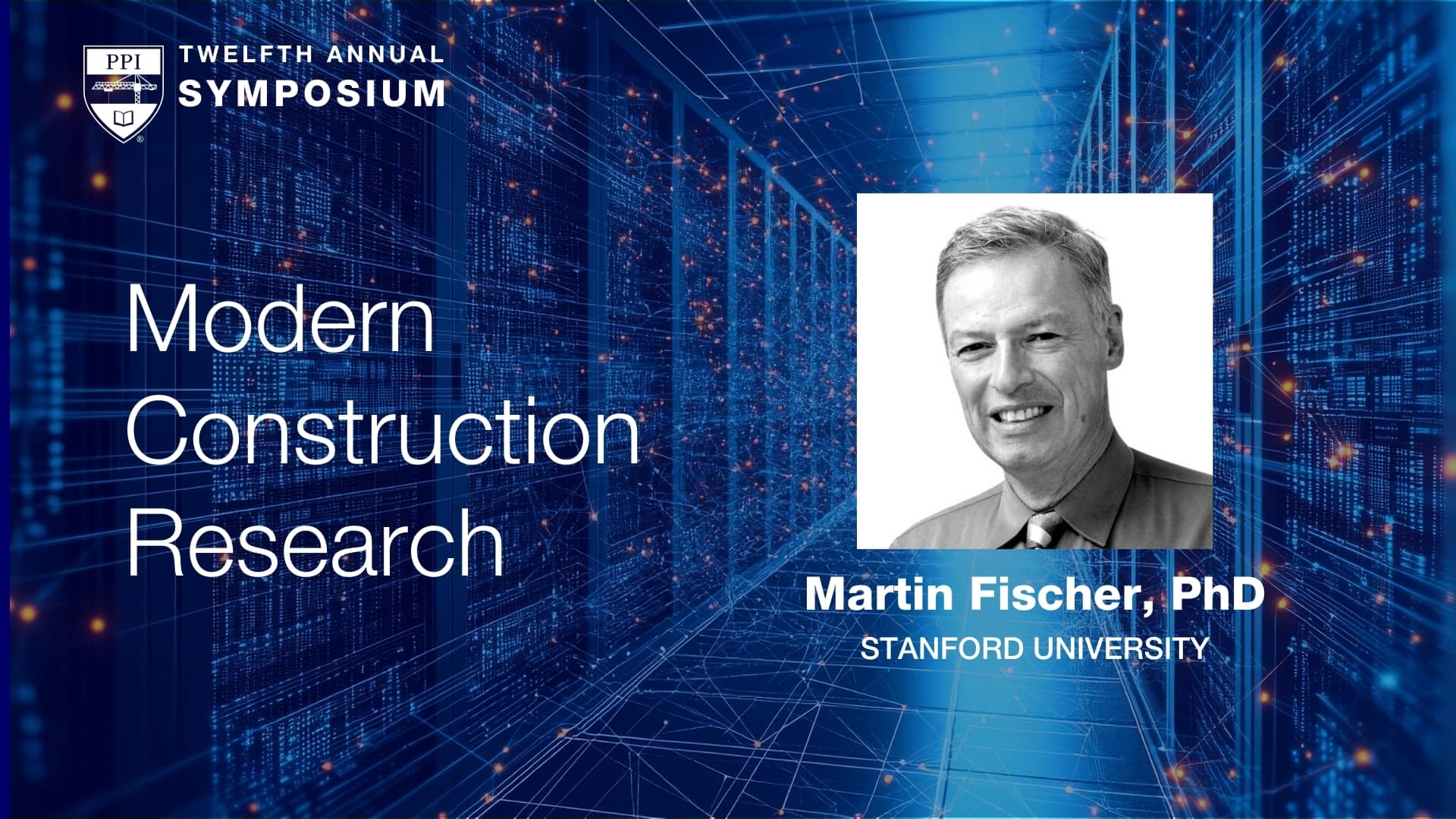
[00:00:00] Gary Fischer, PE: Our next speaker requires Martin requires a little introduction as well. Martin is the professor of Civil and Environmental Engineering, director of the Center for Integrated Facility Engineering at Stanford. A great collabor collaborator with PPI, his re you, Simon, the video earlier today.
[00:00:18] Gary Fischer, PE: His research focuses on modeling, predicting, measuring, and improving lifecycle performance in the built environment. We wanna hear all about what’s going on in your world, Martin. And one, one question that came up in particular earlier, what are we doing to drive the understanding and education of Operation Science and PPM into the graduate and maybe even in the undergraduate program.
[00:00:40] Gary Fischer, PE: So maybe you could touch on that somewhere in your remarks today. So I’ll turn it over to you.
[00:00:46] Martin Fischer, PhD: Thank you Gary and everybody at PPI. Yeah, for the indeed extremely inspiring collaboration. So I titled my talk here in terms of what’s going on here, give you a glimpse with better aligning demand and supply because this is something I really learned from PPI and folks there to look at our world through this lens of demand and supply, which we tend to do, of course, quite normally.
[00:01:17] Martin Fischer, PhD: Sorry, there’s a bit of noise outside. Which we tend to do for many other things, but it’s not terminology that I find used very much in our industry, but I found it extremely helpful. To think of it in this way and I’ll share how we bring these concepts to our education, but also to the world through professional education.
[00:01:46] Martin Fischer, PhD: And give you two examples of research that’s going on, that’s working on this. ’cause everybody these days is subjected to the. Just crazy increase in digital methods that we see get bombarded with every day leading to autonomous systems. We see that with Waymo and so on in San Francisco already and in many other areas.
[00:02:15] Martin Fischer, PhD: That’s certainly on the horizon for us as well. And then also the industrialization of our work, the shifting of work away from the work phase to other areas, whether that’s on site or truly offsite. All of these changes are happening as we speak all there. These opportunities exist as we speak, and we can’t really open a book.
[00:02:45] Martin Fischer, PhD: That tells us, here we go. This is how you live and work and manage in this world. As you know also from, PPI, we have fundamentally five levers to really think about this, what what what truly is the effect of these major innovations that we have at our disposal these days. In terms of how we design and manage our work.
[00:03:13] Martin Fischer, PhD: And so I will show two examples from our research kitchen, ongoing projects with a call for health and participation. I hope that’s okay. And one focused on product design and the other one process design. One focused a bit more on understanding demand better and creating a better demand. And the other one focused on really also changing the, the process design.
[00:03:38] Martin Fischer, PhD: Which, yeah. So one is focused on managing the design changes for complex production facilities. And the other one is creating multitask robots. So what, we’ve had the pleasure to work with several organizations in the semiconductor space, and we’ve been able to do two case studies from where we were able to observe the problems you mentioned.
[00:04:02] Martin Fischer, PhD: And then the method that we have prototyped. This is worked by Lou Sini, one of my PhD students. Basically what we found that these manufacturing facilities like semiconductor plants, face cost and delay risks due to frequent delay changes in industrial requirements. And they could say maybe you could just nail down these industrial requirements better.
[00:04:24] Martin Fischer, PhD: But obviously these facilities are there to support the industrial process and the products that they’re produced. And obviously those are being designed and, change as we start the development of the facility. And you know this world very well. And these changes are just a fact of life and cannot really be eliminated.
[00:04:47] Martin Fischer, PhD: But what we have seen is it’s extremely challenging for project teams to keep track of all the requirements and make sure that these changes get incorporated quickly and and that the repercussions are understood. I think this is the world many of you live in. So yeah, then we talked with engineers in those organizations basically said yes some automation, some increased automation would be helpful.
[00:05:13] Martin Fischer, PhD: So we looked around. And what did we see in various parts of the design space? In terms of methods that look promising, we tried quite many. The list of things we tried is actually quite a bit bigger, but we basically the current configuration of, this process. Focuses on managing the requirements and and providing a configurator through automated methods.
[00:05:44] Martin Fischer, PhD: So that. The changes in requirements and the repercussions on the design can be can be understood better. And it’s a five step process in terms of, course, you have to lay out the requirements and, structure. This particular case, the fabrication facility. Then we have found the design structure matrix, a method that has been developed.
[00:06:10] Martin Fischer, PhD: At MIT quite some time ago very helpful to really understand the interaction of these requirements. We need to allocate these requirements. We need to create a multidisciplinary structural matrix. And then from there we have the basis for a grammar based configurator. Where we don’t need to invent everything from scratch every single time.
[00:06:39] Martin Fischer, PhD: That’s basically the idea of the grammar there. So we’ve seen elements of these methods used, for example, in aerospace and in auto design sectors. But we haven’t seen them pull together as a method to help manage the design changes. And corresponding requirements changes for complex industrial facilities.
[00:07:01] Martin Fischer, PhD: I realized that would be a lot to unpack. I realize that there’s probably a little bit fast, but basically what we have found when we have applied this method to examples from those, case studies that with a software implementation of this method, we could be dramatically faster than the project team.
[00:07:26] Martin Fischer, PhD: And I think those of you that have done design automation will believe this incredible speed increase. Otherwise it sounds probably a little bit crazy. But we have seen this in other fields as well. And also allows you to handle many more requirements simultaneously and and keep track of that.
[00:07:52] Martin Fischer, PhD: If this sounds at all interesting, we’d love to have a rich conversation. I realize that was extremely fast. But the idea was just to give you a very quick glimpse. This is something we’re working on because we’ve seen these requirements and design changes as yeah, major ways of improving the value of the facility, but also major headache for the project teams to need to deliver those facilities.
[00:08:15] Martin Fischer, PhD: So we wanna support that by creating better methods and tools. So if this is all interesting and fits in your world, we would, we actually need on the research side a third case study so we can test this approach and and see if it actually works or if we yeah, need to adjust it on the process side.
[00:08:38] Martin Fischer, PhD: One example of research going on my research group. Is that we have been able to study, and I’ve talked about this in previous symposia and COF as well. 38 applications of construction robots on, site. This is the very first case study we did many years ago which was a precursor to the Hilti Chabot, so a drilling robot.
[00:09:03] Martin Fischer, PhD: And but we’ve studied, yeah, 38 such applications. And what we found is that the safety and quality was always better and schedule and cost was very much a mixed bag. And as we reflected on the schedule and cost horizon did always faster and, cheaper. We noticed that 30, one of the 38 of these robots.
[00:09:27] Martin Fischer, PhD: Our single task robots. And of course on the project you have many different tasks you need to do. So if you want to, with the current robots currently available robots to support those tasks with robots you need to bring new robot to the site, even though many look actually quite similar.
[00:09:47] Martin Fischer, PhD: Like we see here, these are different robots that we saw deployed in different parts of the world. And they have a lot of similar elements. As we analyze these robots in terms of what they do and what know how, yeah. What systems or components, et cetera what hardware elements they include, we found just a extremely wide variety of, of hardware. Yeah. That was deployed not on any one robot of course, but when we summed up all the different elements of all the robots, as you can see here an incredible number of hardware components. And our nutritional reflection is that this single task focus makes it quite expensive to bring robots to the site for many different tasks.
[00:10:47] Martin Fischer, PhD: In the trend we see on the robotic on the robot side is to think about multitask robots to design and defectors that allow multiple tasks or to all design a way of changing the end factor very easily so that you can use the same base for different kind of tasks. And this has evolved in industrial robots over time.
[00:11:18] Martin Fischer, PhD: Thanks to the methodology that helps you match what the tasks need with what the robot can provide. So that you can see whether there is a robot good enough to, meet the requirements you for a task or whether you need to innovate either on the task design or on the robot design or both.
[00:11:43] Martin Fischer, PhD: Actually I jump over what is so we have developed a framework to look at building on these 31 case studies of single task robots. We on, the 38 tasks robots altogether to connect construction tasks with the skills required with the robot. And to then also connect that to the, basically the robot the base parts of a robot.
[00:12:10] Martin Fischer, PhD: And of course on the other side of construction task to make sure that it fits with the project specific context. For example, access or wait with sections, et cetera. You would have. So we did, that was actually my student, Al Jing who had been working with Cynthia on many of these cases that has continued his work.
[00:12:32] Martin Fischer, PhD: Looking at all the tasks from these studies we have done, and basically look at the skills required for the tasks for these tasks. Such as mark spread dispense, through fill. And then what kind of what kind of your skill is needed? Is it talk based joining? Is it impact based, joining press, fit, joining and so on?
[00:13:01] Martin Fischer, PhD: What sub skill is needed in terms of grinding, sanding, echoing. These are just examples. And so from all those examples, we’ve pulled together an initial taxonomy of. Skills required. And then so that we can, I know this looks a little bit crazy, but so that we can understand a particular task through all the skills that are needed so that we can then match a particular task with a robot and we can then.
[00:13:34] Martin Fischer, PhD: Look at sequential tasks on a project and see how similar, different, the skills and the skill families are, and therefore, how feasible might it be to deploy a multitask robot that could be on site, for, several tasks ideally sequentially or following each other fairly soon. And and so this is basically where we are in the research we have developed this skill families, the skills matched into the tasks we saw on those cases.
[00:14:07] Martin Fischer, PhD: And basically what’s needed now is to again work with new material. Where we can study the requirements of the tasks in terms of what weight needs to be lifted, how far does it need to be lifted, how precise does the adjoining have to be, or whatever the particular skill needed is, and so on.
[00:14:30] Martin Fischer, PhD: So to validate this taxonomy and then start to think about how can we, how does that help us design appropriate multitask robots? That should make the deployment of robots more productive on site. And as you can see from the five levels change those change the process design, give you opportunities in process design.
[00:14:54] Martin Fischer, PhD: So there’s a couple vignettes of the research that’s going on as we speak. And if any of it sounded interesting yeah, please get in touch. We’d love to work with you. There’s many other projects going on, so we are always open to explore ideas or to share more about what we do. But I wanted to just share a couple examples.
[00:15:13] Martin Fischer, PhD: But we don’t just do research. We teach, we teach of course our students and we also teach professionals. And so I wanted to give you two quick examples of what we’re doing in this respect. Thanks really to the collaboration with with PPI. Together with James True and also my former PhD student joining more.
[00:15:38] Martin Fischer, PhD: We taught CE 2 41, managing fabrication and construction this quarter. We had the final presentations earlier today, so that’s where I was. And so an example. And so we had a a final project in the class where, so sorry. Stepping back, we teach how to think about demand through the use of generative construction simulations.
[00:16:04] Martin Fischer, PhD: Deploying a tool like Alice and we teach how to think about supply through the application of production, system thinking project production modeling operation science. And then students chose a project to go deeper in one of those areas. And so here is a glimpse of what this one team did.
[00:16:31] Martin Fischer, PhD: In an AI generated picture, the two students that were on this team, but we gave them a realistic scenario of welding, pipes, a pipe rack, and bolting pipes. And they had to think through quite many production constraints. For example, what would happen if you could only get so many crews and you still should try to make, meet your schedule.
[00:16:59] Martin Fischer, PhD: What changes could you do? How could you make it possible that the schedule could still be met or we. What if there’s a design change and you have to deal with pipes that are, some pipes that are larger and others or the original design. We also gave them a scenario of an innovative way of doing QC on a on four welds.
[00:17:26] Martin Fischer, PhD: That would allow you to reduce rework. They had to think through the impact of rework. So basically they got to really exercise operation science in the context of real situation. Also with data that we were able to give them realistic data you could collect so they get also a sense of the actual variability that exists and what might drive that variability.
[00:17:54] Martin Fischer, PhD: And in the end we asked them to think about the particular innovation we shared in terms of the qc innovative QC procedure. And I should also thank Dan Rayhill, who’s also been often in the PPM community in the PPI community for the support of this project study. And we asked them, how much would you be able to pay.
[00:18:20] Martin Fischer, PhD: For this innovation given the scenarios that you saw. Change to comment he’s more the expert here, but I felt like in a relatively short time, the students got a reasonably good grasp of the ideas behind PPM, and many came up to me and said. I can’t look at the world any other way.
[00:18:43] Martin Fischer, PhD: Now, I now I try to look for, I look for inventory and work in process all the time and look for variability all the time. And I realized how important this, and 10 weeks ago, I had no idea this is so important and we should pay attention to it. And on the professional education side we shared this in a previous symposium actually last year we graduated the first group of professionals that went through this professional education program.
[00:19:10] Martin Fischer, PhD: We call it the modern construction program, where we really think through how these three. Major areas of opportunities, industrialization, autonomy and digitalization. Combine change or inform how we use those five levers. So we create better designs, better demand, better supply for our projects, better production system.
[00:19:37] Martin Fischer, PhD: And what you saw, just to remind you to give you an idea what the people. The professionals went through this program the certification program. What they what they learned is we had one student that looked at amazing only process. And really carefully mapped the measuring process, which allowed them to become very clear on what is actually the bottleneck.
[00:20:02] Martin Fischer, PhD: And was able to reduce the average cycle time from 45 to 16 days. That had like major benefits, of course on the project. And the other student looked at the design change review process. Ways of automating aspects of the design review and basically found a way of reducing the average review time, which was at 26 weeks to to 16 weeks.
[00:20:29] Martin Fischer, PhD: So to, to illustrate, yeah, these are just a couple snapshots from the implementation from on the Masonry project. Here’s the identification of the bottlenecks. And then I was able to develop a, as you saw, a process that had significantly lower cycle time and he felt gave much more control to the site management team and on, the student that looked at the design review again through careful modeling of the design review process was able to improve the design review. Process on that project, but probably just as importantly, or maybe even more importantly for them was able then to formulate a long term strategy for automation and digitization.
[00:21:22] Martin Fischer, PhD: That was really rooted in how things are actually really happening and was therefore much more realistic and could be communicated much more clearly to the other people on the team. So if you’d like to do things along those lines join us for the certification program. It’s not just a week of listening to us.
[00:21:46] Martin Fischer, PhD: And then we send you off into the world. No, we we have that part, but then many workshops and then you get to apply operation Science in your work and get feedback from us so that you. Hopefully get the money you invest and the time you invest in the program, back through the program, through improvements you can see as you can see I think not totally unrealistic given the examples that I just shared.
[00:22:13] Martin Fischer, PhD: So those are the couple things we’re doing on the education and the research side that benefit very much from the collaboration of VPI and the concepts that we are learning there.
[00:22:27] Gary Fischer, PE: All right. Got a question for you, Martin. Are you exploring how the application of robots can change the shape and form of construction materials that are sized sometimes for human construction workers, perhaps as secondary optimization?
[00:22:43] Martin Fischer, PhD: Yeah. Not. Not that much. That, that is certainly an opportunity.
[00:22:49] Martin Fischer, PhD: But those kind of changes seem a little bit tougher to, to implement. So as we saw from, research that my colleague Ray Levitt did, the more things you have to change when you innovate the slower. The adoption. And I I very much sympathize with that point. On the other hand so much of the material supply chain everything, design methods, et cetera, are based on the shape and materials.
[00:23:22] Martin Fischer, PhD: But I totally agree that this is definitely an opportunity, but I see it as a bit of a longer term play.
[00:23:30] Gary Fischer, PE: It’ll probably happen someday.
[00:23:32] Martin Fischer, PhD: Yes. Yeah. No I’m sure it’ll happen. Yeah. I’ll happen.
[00:23:36] Gary Fischer, PE: Yeah
[00:23:37] Martin Fischer, PhD: Yeah.
[00:23:39] Gary Fischer, PE: I think of my, the evolution of Legos started out pretty simple now, man, I put some together this last weekend, man.
[00:23:47] Gary Fischer, PE: They were not simple and you had have little special tools to put ’em together. So clearly the thinking is gonna advance. Yeah.
[00:23:54] Martin Fischer, PhD: Yes. No, I totally agree.
[00:23:57] Gary Fischer, PE: That’s, very good. Martin, thank you for sharing some thoughts.