Expedition Engineering


Four industry leaders debate what owners should do differently on data center and infrastructure projects, challenging assumptions about contracts, administrative burden, decision rights, and the fundamental difference between project management and production thinking.
Four industry leaders who rarely share a stage together tackled the question every data center, power, and civil works owner should be asking: what would we do differently if we actually wanted to get the value we’re paying for? The answer isn’t better contracts or more oversight. It’s bringing builders into the room before the design is locked, designing the production system before designing the asset, and stripping away the administrative burden that consumes the best talent on every project.
Don’t confuse this with easy. It takes conviction, and you’ll often feel like the only one in the room. But you’re not alone.
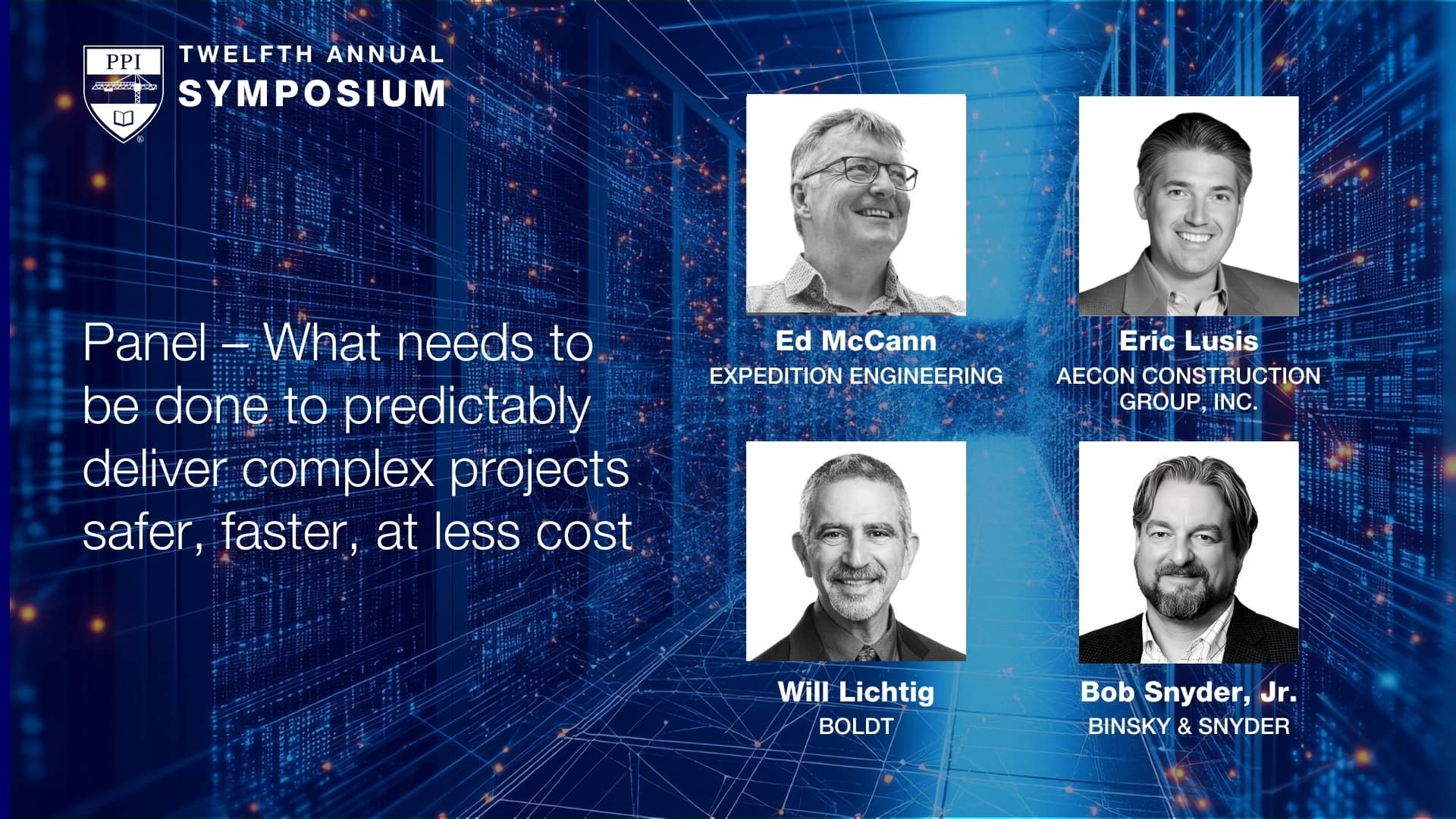
[00:00:00] Gary Fischer, PE: We’re gonna move into what I think is gonna find a really interesting panel discussion. So Ed, excuse me. Eric Lewis. Will you’re there. And Bob, can you turn on your cameras so we can get our panel up here?
[00:00:18] Gary Fischer, PE: So some of you may be just tuning in, so I just. Real quick reintroductions here. Ed McCann is the Senior Director at Expedition Engineering, as the Chief Innovation Officer and Executive Vice President at Bolt. Bob is the owner of the Binky and Snyder. Everyone that e but Eric’s been introduced earlier.
[00:00:39] Gary Fischer, PE: So Eric Lucas is with acon, has over 25 years in the a EC industry. His passion is helping teams make their work easier, provide outstanding results. Eric is an experienced facilitator, countless design and construction groups to develop high performing teams and projects. This includes project alignment, team partnering, validation, design planning, construction planning and execution through asset activation and closeout.
[00:01:03] Gary Fischer, PE: So we get this great panel. I just imagine what would be like if the four of you collaborated and developed a project and executed a project together? It would. It would be phenomenal. Anyway, so let’s back up. Ask an open-ended question here and we’ll see what, see where it goes. So if you were responsible for a new data center Power or Civil Works project, what would you propose be done differently to ensure the owner gets the value they seek?
[00:01:30] Gary Fischer, PE: Maybe Bob, let’s start with you. Oh
[00:01:34] Robert Snyder, Jr.: I think he put the builders in the room. And you start banging out a construction production system for engineering through a really commissioning, I think you pick your milestone you wanna pull from, and that should be in the pharma world, it’s ready for science.
[00:01:52] Robert Snyder, Jr.: In the data center world, it’s probably. Light on or whatever it needs to be. But I think you all work to create a high level production system, and then you look for bottlenecks and then as you work through it, you start to attack the bottlenecks. Bottlenecks similar to what you know Roberto did with his supply chain.
[00:02:09] Robert Snyder, Jr.: You look at stuff that the long leads, you got eight weeks, you got 10 weeks, you got stuff that’s two weeks. Let’s attack the things that are truly the bottlenecks and the long leads. Eric, what would you do differently?
[00:02:23] Eric Lusis: I think one of the first things I do is design the production system before the de designing the asset.
[00:02:30] Eric Lusis: So many of our teams we we have these deliverables, we owe something in 90 days. We haven’t even met each other very well, let alone agreed to the processes of, in our approach to the project. So I’d really spent a lot of time defining how the project will be built as well as how we’re gonna approach the design thinking and really looking at its flow, the sequencing, the constraints of the project.
[00:02:57] Eric Lusis: This was close to one of Ed’s examples of where they, actually, they set up the design to match the actual installation of those sequence of work. And that’s the, that’s a great example of thinking this way. And really doing that thinking and planning as a team before finding the key design elements and, really this is trying to ensure the constructability and the efficiencies that that, projects need are baked in early.
[00:03:27] Gary Fischer, PE: That’s good. Ed, what are your thoughts?
[00:03:30] Ed McCann: Sorry, not wanting to repeat ’cause I agree very much with what Bob and Eric have said. But to expand slightly I’d, really wanna understand what’s get, what’s going wrong now. And so before designing a solution, I’d be quite keen to understand what the issues are that they’re facing.
[00:03:46] Ed McCann: And some of the stuff we find is long before the point we’re talking about here. In the consenting process and the funding process and what if you pardon my French, what one senior director put to me the other day, the white full of bullshit that slows everything down. And so I don’t know whether they have those sort of problems on the data centers we’re talking about here, but we have them on most infrastructure projects.
[00:04:10] Ed McCann: And so really trying to understand. What is getting in the way of smooth operation. So as well as what the other guys are saying, I think really gripping the totality of the system, including all the prep work, the governance structures and so on. I chuck that in as well.
[00:04:27] Gary Fischer, PE: So you mentioned in an earlier conversation that from your point of view, things go off the rails right.
[00:04:33] Gary Fischer, PE: At conception of the project. Can you talk about how you would avoid that?
[00:04:40] Ed McCann: Again it the, sort of stuff that, that is often gonna kill these projects is, not the, build of the thing itself is whether it can plumb into anything. So the classic with data center, in the UK is data center, is their power available for us?
[00:04:55] Ed McCann: And so everyone’s torturing themselves about the design of the data center and actually there’s no power to the site or they haven’t got planning permission for a substation. It’s. A hundred miles away that they need to get the power going. So quite often we find is that there are all sorts of things to do with the consenting process that may be yeah, Not center of people’s attention when thinking about the design of the building and the the procuring contractors to do it. So those are the sorts of things. And we have I, dunno what it’s like elsewhere. But in, in the UK some of the requirements come through the consenting process.
[00:05:34] Ed McCann: Are, just they’re very surprised. Intended, but very surprised. And there was one in the news that a couple of days ago called a, it’s a 700 million pound, they call it a fish disco on the Hinkley Point Power Station. It’s a fish return structure, 700 million pounds. They priced it’s 280,000 pounds of fish saved or something.
[00:05:54] Ed McCann: So it’s come out of a. A well-intended piece of legislation that relates to protecting fish. But by the time it’s rinsed through, it ends up in something that no one can quite believe how you’ve ended up here in both in time and money. So I think yeah, that front end stuff and making sure you’ve got all of that properly resolved as a, sort of yeah.
[00:06:16] Ed McCann: Part of getting a good answer. Yeah.
[00:06:19] Gary Fischer, PE: Yeah. Will, how about your perspective?
[00:06:22] Will Lichtig: I, again, Gary, I think haven’t done this. In multiple industries for a while, I think the first thing I would recommend that a data center owner do is hire a builder first. Don’t hire a cm, actually hire a builder. You need a builder, not a buyer if you want to go fast.
[00:06:41] Will Lichtig: Once you hire that builder have the builder participate both in the bringing on board of the trade contractors who will execute any of the disciplines that the builder won’t do with its own direct hire forces. Hire the engineer that will execute the job. Once that team is on board, I think it’s important for the owner to be clear about what the business objectives are that they’re trying to achieve.
[00:07:08] Will Lichtig: So it’s, they, yes, we’re gonna deliver a capital asset, but the only reason we’re doing that is because of some other fundamental business need. And if we understand the business need and we understand what about that business need matters. We can often help design both the product and process in a way that elegantly provides for that.
[00:07:29] Will Lichtig: So once you have that done and you really understand what are the business drivers, then I think the owner has to be un unpack, if you will. Its legacy thinking around what the boundaries are the, thing, the things that must be done or can’t be done. Because every owner that we’ve worked for.
[00:07:48] Will Lichtig: Has typically done projects before and they already have a playbook. And so I think it’s important for them to disclose what their playbook is. And, I’ll say the why behind the rule. So some people may say, I only use Copper Conductor. I’m making that one up. It’s like, why do you only use Copper Conductor?
[00:08:08] Will Lichtig: Some people may say, I only use precast on the shell, these shell of these buildings. It’s like the team shouldn’t. Accept that, but they have to understand why do you think that way? What’s the why behind the what The owner then needs to be open to challenge. If there’s a, there’s an old saying that a, what a sophisticated owner is buying is not a product, but it’s buying a team to help solve a problem that no one really understands, and that keeps evolving.
[00:08:38] Will Lichtig: So if you’re gonna leverage the capabilities of this team, then part of what you need to do is listen and be open to challenge. And that doesn’t mean just to accept what somebody comes forward as an opinion or assumption. ’cause the next item I would say is they ha the team has to be driven by what I call data-driven decision making.
[00:09:00] Will Lichtig: We use a, Toyota method called the A three, which basically is capturing on one page the problem we’re trying to solve, the solutions we’ve considered and the reason that we’re making the recommendation that we’re making, and then let the owner make that decision. But, the owner has to be open to challenge.
[00:09:21] Will Lichtig: And I think one of the other things I would offer is I think the owner should be open to a commercial relationship. That aligns all the team members behind a winning solution that focuses on how the production system actually performs. So one of the things I would say I’m, not gonna talk about what form of contract it needs to be, but I will say that everybody’s profit should be tied to the success of the production system, achieving the business objectives.
[00:09:54] Will Lichtig: So I’ve seen over 25 years of, working in different ways that when engineers understand that the profit that they will learn from the job is based on the success of the production system. They, tend as a, group, not somebody like Ed who’s already doing that because he knows it’s the right thing to do.
[00:10:13] Will Lichtig: But the institutions, the organizations, the engineering firms will be much more aligned. To actually coming up with solutions that work for production. If they understand that the more successful production is, the more money we’ll make on this job. So those are just some things to start with. Gary, I think the other thing that owners have to figure out as a byproduct of that, and I, know there’s been some discussion today about what level of administrative control is necessary.
[00:10:45] Will Lichtig: I guess the only other thing I would recommend, whether the, what, whatever level is required, don’t add another layer of professionals, whether you call ’em, program managers, construction managers, whatever else to, provide that level of administrative control. The team can do that for you. It they’re willing to play.
[00:11:05] Will Lichtig: Bob already described, I’m willing to play an open book game every, you can see what I have, but. But don’t add a bunch of checkers to check the checkers. It just doesn’t make any economic sense and it tends to slow the whole process down. So those are just some of the things that I’ve thought through Gary, that I think if I were sitting as a major data center owner, I would do differently if I’m looking to go fast and safe and be very productive in terms of getting the working close.
[00:11:34] Gary Fischer, PE: Yeah. Any thoughts on that? The rest of the panel this is a discussion, so
[00:11:40] Eric Lusis: I love that. Last point will one of my biggest pet peeves is reducing administrative burden. And there’s so much of it. There’s so many layers, like so many. Of the teams that I work with and have worked with just are really administrators of stuff versus like really focusing on the work.
[00:12:00] Eric Lusis: And a lot of times that happens because we begin to just manage like bureaucracy and all of those layers. And that’s one of the challenges that slows work down. And it’s like spending most of our effort dealing with change versus being proactive and looking ahead and trying to figure out how do we.
[00:12:21] Eric Lusis: Avoid continual change in, the first place. And that’s one of the things that I’ve I highly focus on is trying to figure that out. And that goes right back to really aligning what the production system looks like. Who are the decision makers how do we make decisions so we’re not becoming reactive over, over the lifecycle of the project.
[00:12:46] Robert Snyder, Jr.: Yeah. Mean, what we’re, what we find is contractors that, who are doing the work. We’re resource constrained. We don’t have unlimited resources. We need the best quality resources. And the administrative people think the administrative piece is just easy stuff to do.
[00:13:08] Robert Snyder, Jr.: But when you’re really pushed on a lot of administrative activities. What happens is your best people get put on that in order to satisfy the owner because it’s not fill out a form. It’s how do you calculate the amount of footage of pipe that you did on this day, blah, blah, blah, blah.
[00:13:25] Robert Snyder, Jr.: And I need to use our people who know how to build to provide that administrative data. And what does it do? It takes ’em off of building. So you’re taking your people and your folks with the highest level of an of building intelligence, so to speak. You’re shifting them over to administrative activities and you have this giant hole on how do you actually run a production system and put it in control when really your folks who know how to do that the best are really getting sucked into this idea of earned value and those administrative type activities like billings and things like that.
[00:14:00] Robert Snyder, Jr.: And, there’s a lot of strategy attached to those administrative activities if you wanna make money. So it’s a it’s a, it’s administrative. When it comes to it not being the actual work, but it’s not unimportant and it’s not busy work. It’s important work that we’re doing.
[00:14:20] Robert Snyder, Jr.: The other thing would be is every time we provide an administrative activity or data source to a construction manager owner, because it doesn’t solve their problem, they ask for something else. So it becomes this how much can we ask the subcontractor for, to try to solve our problem in the administrative world?
[00:14:41] Robert Snyder, Jr.: But it never really solves the issue. So it, you actually create your own. You’re better off getting yelled at and not doing it. Almost and worrying about your own thing, because at the end of the day, the production system solves the problems. So it’s this quandary that we’re in that just it’s, I think it goes back to what Will said is let’s, get the builders on board early and let’s, start looking at the work itself first, because that’s what drives the project.
[00:15:09] Robert Snyder, Jr.: Yeah.
[00:15:11] Ed McCann: I, was going to reflecting on the role of the people and we, talk about building, bringing the builder on, or the engineer and the client as individuals. I think one thing to recognize is that those are not uniform entities. There is a massive difference in capability, motivation, contribution that comes from those characters.
[00:15:36] Ed McCann: I’ve seen plenty of examples of bringing builders on early that makes the situation worse, not better. It depends who the builders are. And similar, same with engineers and same with clients. By the way, this is not a I’m, just making a general point, is that the, capability of the individuals and the, organizations is really important.
[00:15:56] Ed McCann: So I think there’s something about. Seeing into the humans that are doing the work with you here is, in my experience, very important. The other thing I would say, and I is, it comes again from my experience working with a lot of builders is build builders typically get into real trouble. If they don’t do what they’ve said in the time they’ve said they’re gonna do it they, they have to perform.
[00:16:19] Ed McCann: They lose real money real money. They’ve got little options for getting around it and sometimes. I see in, in, in certain, and I don’t know what the situation is in Bob’s outfit, but the way in the UK a lot of the contractors have managed their business is to turn themselves into combo businesses where they do plant hire and contracting.
[00:16:41] Ed McCann: And one of the unintended consequences of essentially having a business with loads of plant you’re gonna hire from yourself is that everything ends up using the same bit of kit. And, this, in my experience, can lead to deep suboptimal solutions because your builder is gonna do it the way that suits their kit.
[00:16:59] Ed McCann: Rather than the way that necessarily suits the project. And so I think what we’ve increasingly found is that what you need is the capability of a builder. You need people who understand how to build stuff, but you, but whether you actually want to be contracting someone before you’ve understood what the solution process is that you want to use I’m not so convinced about.
[00:17:20] Ed McCann: And I think that y yeah. Particularly when it comes to specialist tooling operations and Yeah the, tendency towards the average bit of kit to do everything, the average excavator, the average digger, the average I, think that one of the huge opportunities for us in our industry is like manufacturing to be retooling progressively and improving the quality of our tooling, which the business model of a lot of contemporary contractors, in my experience anyway.
[00:17:50] Ed McCann: Doesn’t suit because they’re hiring a bunch of standard kit out to themselves. I dunno whether that’s the thing in the stakes by the way. But over here you often get the builder is actually is owns and sells or hires the kit, particularly big civil contracting outfits.
[00:18:07] Gary Fischer, PE: Makes sense. So I got a interesting question here.
[00:18:12] Gary Fischer, PE: So by the sound of things, none of you want to start. With getting an agreement about how you’ll work together through, say, relational contracting rather than transactional contracting to enable the solving of the problem that no one really understands at the start.
[00:18:31] Will Lichtig: I’m gonna, I’ll take a stab at that first. ’cause it sounds like the same to me. I look, I’m just trying to be contract form neutral here. In other words, people out there know, I’ve heard people say that I invented the integrated form of agreement, so it. I’m clearly somebody who believes in that.
[00:18:48] Will Lichtig: And if the owner can only do design build work, or the owner needs to contract in some other methodology I guess what I’m saying is you can achieve the objectives that were just described in that question. The idea that it’s not transactional, that it’s relational within the framework of different forms of agreement.
[00:19:08] Will Lichtig: So long as everybody is focused on the same business objectives and you’re aligning. The production system, the design system, and the commercial system in a way that everybody wins or loses together. So that was the bridge I was trying to build in that discussion of aligning commercial interests with what should be the operational and organizational interests of how to best run a project.
[00:19:33] Will Lichtig: So if you have the ability, if someone had the ability to contract using some relational. Form of agreement, whether it’s the IFOA or others that exist on other continents, then by all means, I think that will make it easier. You won’t have to worry about getting the contract out of the way, but I also know that there’s some organizations where the engineering and construction group would love to do something different tomorrow, and they don’t want to have to spend six months fighting with legal and accounting to move towards a different form of agreement.
[00:20:07] Will Lichtig: So let’s not let that. Be an absolute impediment to doing what’s right.
[00:20:12] Gary Fischer, PE: Yeah. Hopefully that answered the question. Any other points of view on that before we move on to another question?
[00:20:20] Robert Snyder, Jr.: I, don’t think the form of agreement. I think that’s, you can do all of these things with any form of agreement. Yeah.
[00:20:29] Robert Snyder, Jr.: I, don’t, think in general the commercial terms solves the problem, although you have to have the right commercial terms. So everyone feels that they’ve a there’s an equity across the platform that every, whether that’s shared profits or whatever it is, it’s we, it’s. The biggest complaints are, oh, this person’s making more money and he’s not doing as much work.
[00:20:48] Robert Snyder, Jr.: So as long as you have a contract agreement across all the, trades or all the stakeholders so to speak, and everybody feels like everyone’s being treated fairly and equitably, I don’t think it really matters whether it’s IPD or design build or any of those things.
[00:21:03] Eric Lusis: And incentives don’t need to wholly be money, right?
[00:21:07] Eric Lusis: There’s a lot of incentives with working with various participants, whether it’s an organization who wants to. Be more involved with a project type and do more of that type of work or other types of opportunities where they’re clearly defined. Like what each group is getting out out of participating with a project first approach.
[00:21:31] Eric Lusis: And, it doesn’t wholly need to be monetary.
[00:21:35] Robert Snyder, Jr.: I would agree with that completely. Just it’s, quite if someone said I could make 15% profit or make 10% profit if we did well and guarantee the next project, I would take the 10% every day. And I think that people look at that as the carrot because it’s display it’s told to us as a carrot, it’s it, you don’t do this well.
[00:21:58] Robert Snyder, Jr.: There’s no opportunity for you to get the new job. Instead of saying, if you get this job done on this date, you’re gonna do every single job. And I think that’s a much higher motivator than the financial piece of it. Yeah. Yeah. Like the learning.
[00:22:15] Ed McCann: Go ahead, ed. No, I was just gonna say I, it we, looked quite a lot at what drives behaviors in different tiers of the supply chain in a sort of UK context.
[00:22:27] Ed McCann: And it was really clear that if what we would call a tier two contractor direct labor and carrying plant, they were far more interested in continuity of work than ever. They were super profit or outperformance profits on individual contracts. And actually some of the best contracts are where you’ve got two or three people and basically they beat, they race each other on performance for the opportunity to con for continuity of work.
[00:22:53] Ed McCann: It drives actually really good behaviors ’cause they try and improve safety stats or production output rates or, whatever it is. You, You’re lining them up and you’re saying, if you do these things on this project, if your production rates are as good as this, if your health and safety stats are like this, you and so on, then you, are first in the queue for the next one that comes along.
[00:23:12] Ed McCann: So I, whereas I think actually, if you’re not in that situation other, sorts of incentives are more relevant to you. But certainly with the, with a lot of these turnover based businesses, three months of no work is. Far more important than one heroic six month project, which you make 30% profit on.
[00:23:33] Gary Fischer, PE: Yeah, for sure. So I got another good, question here. How do you partner with the team during the planning, project? Execution, rhythm of meetings, oversight, escalation, balancing what’s needed and avoiding unnecessary burdens.
[00:23:55] Eric Lusis: It’s gotta start with defining the objectives and value from the client’s perspective and conditions of satisfaction are the key components. It’s always gotta start there.
[00:24:10] Will Lichtig: I guess one of the other things for, again, bringing it back to the context of data centers and data center owners. So one of the things I learned fairly quickly when I moved from working in healthcare to moving to working in industrial and data center work is the speed at which projects move.
[00:24:28] Will Lichtig: And my experience has been that when you move into the industrial and data center market, you gotta be able to move it a sprint from about day one, if not day zero. So I, I do think that to the extent a customer can find a delivery team that’s actually worked together before and has worked out some of the general ways that how we work together as companies and are aligned in that way, that you’re gonna get faster up.
[00:24:55] Will Lichtig: That learning curve with the team doesn’t mean that with new people you won’t have to onboard and make sure that everybody’s on the same page, but you won’t have to start it at ground zero. Gary, I guess I would also offer then what we, would typically do then is design that process.
[00:25:13] Will Lichtig: So it’s not one size fits all. Different customers have different rhythms that they can move at. They’re different folks that are involved in each of their organizations that either have a stake or a role to play in the conversation. But we would actually design the front end system of, how we’re going to proceed through that design process.
[00:25:35] Will Lichtig: We want integration, but we don’t want people sitting in meetings just to sit in meetings. We want to have people come together for a purpose so that it’s not just we, come together and talk about whatever got left over from last week’s meeting, but it’s, here are the six things that need to be decided this week.
[00:25:52] Will Lichtig: We’re gonna come into a room, everybody’s gonna be prepared and know what those six items are. We’re gonna hash through and make a decision and adjourn the meeting and move on and identify what are the things that need to be identified and, decided in the coming weeks. So we often view, again, ed probably can think about it this way as well.
[00:26:11] Will Lichtig: We think of it as design, as just a series of decisions that are then reflected in the design that emerges from the team having made stable decisions on how a particular problem is gonna be solved. Again, the approach we take is typically starting with at a system level and then moving down to designing and detailing.
[00:26:32] Will Lichtig: And again, it, we view it as an iterative conversation between process design and product design. I don’t think you can design the entire production system before you actually begin the conversation about what the product actually needs to be, but I think it can be a dialogue between product and process.
[00:26:53] Ed McCann: I think that’s right. Sorry Bob.
[00:26:57] Robert Snyder, Jr.: Will, one point you made that’s really interesting is, that everything we do is a production system. So does the way we design the production system, in theory is a production system, right? So thinking through that lens, and understanding how do we do anything?
[00:27:16] Robert Snyder, Jr.: And if you look at it through a production lens and create production systems for anything. Even even administrative tracks are production systems. So you take on a different level of thought and really looking at all even simple things that we just have to accomplish.
[00:27:33] Robert Snyder, Jr.: And some of it is actually how do we do something and not necessarily the doing of it itself. The. It’s not just a production system to build an engineer project. It’s all of the processes that can be looked at through that lens and how do you shorten and the, cycle times for any one of those is really a, pretty big deal.
[00:27:55] Robert Snyder, Jr.: And I think it’s again, it’s a we go to the coffee line. I had an experience with Mark Spearman where we had, we were at a conference and we looked at the coffee line. It was the Starbucks coffee line actually, and we noticed that. There was no line at all. None. But there was a hundred people waiting for their coffee.
[00:28:14] Robert Snyder, Jr.: They were gr and it was designed specifically. No one’s leaving after they paid. And I dunno, mark remembers that, but it was. And we laughed and said, this is a perfectly designed production system that is delivering exactly what they want. They want the money. They don’t care if the guys gonna have to wait 20 minutes for their coffee because they’re not gonna ask for the money back.
[00:28:36] Robert Snyder, Jr.: So it’s everything is a production system, even the way you create them and even the way you design how a project works.
[00:28:42] Ed McCann: I think I, I think that the, sort of designing the bureau bureaucracy is normally viewed as very bad word, but actually there’s a beautiful bureaucracy that makes this stuff run smoothly, and you have to design the bureaucracy.
[00:28:54] Ed McCann: The one thing I would say is, whoever is designing the bureaucracy wants to be someone who doesn’t like bureaucracy. The washing machine wasn’t invented by someone who liked washing clothes. It was designed by somebody who didn’t like washing clothes, so it did the job they, and so I think that, and this is joking aside, when I look at these big mega projects and the people they put in to design the bureaucracy, you wonder what on earth they’re.
[00:29:23] Ed McCann: You’ve got org diagrams at three levels down. They’ve got 3000 jobs in them, you know that. And and, the sort of thing they do is, they’ll take a they’ll, do a racy, and every single responsibility turns into a discreet human being. This sort of thing. So somehow these were really dumb thinking that just generates massive proliferation in headcount and process.
[00:29:46] Ed McCann: And then of course, you’ve gotta manage all of them. So you get processes on, or systems onto systems, and then someone’s gotta re And so that, that tendency has to be absolutely fought ruthlessly. But it is, absolutely essential. You need bureaucracy, you just need the right sort of bureaucracy.
[00:30:03] Gary Fischer, PE: So you’ve all, talked about.
[00:30:06] Gary Fischer, PE: Kind of the weight of administrative burden. Let’s bring that to life for a minute. Let’s take a risk here. What if you were king, what administrative burden would you lift off of projects?
[00:30:20] Eric Lusis: I’d shift the responsibility of who and when we make decisions, right? And particularly with design.
[00:30:29] Eric Lusis: Or I guess as an example of like design and engineering thinking, it’s often we’ll put together like a, linear schedule and we’ll hope to achieve that and, not bring in the people who, are actually. Focus on the key components often enough and and trusting those an example is the cluster group, right?
[00:30:56] Eric Lusis: And you’ve designated a cross-functional team to come up with a options and and. Up where the dates can’t move. And so this is why we’re gonna not only have one option, but we’re gonna have a couple to reduce our risk with, making a, an informed decision and then integrating those say at a big room event where you know, we’re there and we’re gonna make a decision, we’re gonna move on.
[00:31:27] Eric Lusis: We’re. Highlight why we made the decision to move work faster versus a lot of the typical project controls functions and the cycles and processes that really just add a lot of administrative management.
[00:31:47] Will Lichtig: So a couple of ’em that come to mind. Gary, I think I think. A sophisticated owner can rethink its invoicing and payment process in a way that takes a lot of waste out of the system.
[00:31:58] Gary Fischer, PE: Yeah.
[00:32:00] Will Lichtig: We’ve worked with customers that have gotten that process down to a, to five days, and meaning the turnaround between the time the period closes and the time the cash is in the account is five days, and that it’s aimed at being cash positive for the team actually executing the work.
[00:32:19] Will Lichtig: But it doesn’t involve creating these reams of paper that nobody really looks at every month, or somebody does look at and finds a nickel invoice for a cup of coffee and then holds up the entire pay request. So there, there are ways there, I think at the ri, at the risk of saying something dangerous.
[00:32:37] Will Lichtig: I will say, I think that organizations can re-look at their project controls process. I am not an advocate for abandoning project controls. I think there is a place for project controls. But I think that those who have grown up in the more traditional C-M-C-I-I-P-M-I kind of approach to project controls are probably strangling their projects with unnecessary non-value added efforts.
[00:33:07] Will Lichtig: And that there are ways to assure that. We are checking to assure that we’re achieving what we plan to, or if we aren’t, what are we gonna do to correct it without the huge costs and administrative burden that are embedded in a traditional project control system. I, think those are just a couple of examples.
[00:33:30] Will Lichtig: Again, a lot of customers also have. Monthly reporting requirements that instead of looking at what are the things that the people operating the project should be looking at in terms of data and action plans to correct anything that is not performing in the system the way expected that it can create a huge administrative burden on a team to actually produce a monthly report that nobody probably reads and, certainly doesn’t produce the kind of action that anybody is entitled.
[00:34:01] Will Lichtig: To take based on it. It’s, it is almost like it’s an artifact to assure that if and when we get into litigation at the end, there’s something that describes. What somebody saw is this snapshot in time.
[00:34:14] Eric Lusis: And, like often that reporting is a month or plus old. So you know, like how fast are we informing ourselves to make decisions.
[00:34:23] Eric Lusis: Gary, on this one point, I’m wondering if I could have one minute to just share a slide. ’cause I had a team basically look at all of their work and they mapped out how much is planning, doing, checking versus adjusting. Sure. Real quick. I’ve got it. I prepped it just in case we were gonna hit on this topic here.
[00:34:40] Eric Lusis: And this was one of our, this was from our nuclear sector and they, basically, this was a project wide effort to reduce the waste on their job. And literally they, mapped out almost 60% of their work was just checking stuff, right? So if we’re trying to be smarter about our approaches to job, how much of our effort is, focused on planning, right?
[00:35:03] Eric Lusis: Doing and really trying to get smarter as we improve. And so what they’re able to do through this effort was reduce the non-value add time. Of our supervisors by 75%. Now they could have just done the project again and not made these changes. But the thinking is if at any time you’re gonna look at all the things that people are doing, what is the leader standard work?
[00:35:24] Eric Lusis: And I mean that from basically perspective of all the players and stakeholders on job, what’s everybody doing? And oftentimes. What I’ll do is my fourth question is is your role you’ve told me what you do here, but is any of that written down, like literally bullet points, here’s what I’m responsible, here’s what I do and often it’s not.
[00:35:44] Eric Lusis: And being able to see what people do in addition to what the processes are across a project can be really valuable.
[00:35:53] Robert Snyder, Jr.: I think there’s some really interesting other things that don’t feel like they’re so tied to the construction piece. I think one of ’em is this idea of simplification of this tech stack.
[00:36:04] Robert Snyder, Jr.: Make it bottom up, not top down. There are things that we use every day. That if we, could find a way to share that out and then collaborate through the tech stack for the project, we, you should have a project tech stack, and that’s not Procore. That’s an administrative program. Now that’s a really hard thing to do because most of the venture capital money that’s been spent.
[00:36:24] Robert Snyder, Jr.: Which is a ton of pressure on software, and it has been at least 80% driven towards the administrative world, not towards the built world. So that’s one piece of the puzzle. There’s also two kind of interesting KPIs. It’s number of hours per person in meetings and number of people in a meeting.
[00:36:43] Robert Snyder, Jr.: More is not better. Meeting time. That’s whip, that is the worst whip you can have when you sit in a meeting. We’ve all been there with 40 people in it all looking to get something done. You get 40 times less done if than if you have five people in the meeting. So pick the stakeholders. You should be driving towards KPIs that don’t even make sense.
[00:37:02] Robert Snyder, Jr.: Now, in some ways, that works against some of the ways that. People actually making money. So I think that’s a, that’s an interesting piece of it. How much time are we actually spending in meetings and not getting anything out of them, but we have to be there to protect ourselves. So it’s some, there’s a lot of those kinds of things that are easy,
[00:37:22] Gary Fischer, PE: really good examples.
[00:37:24] Gary Fischer, PE: I hope owners and general contractors are, listening carefully to this. There’s, a lot of good food for thought in there. Let’s see. I got a few other questions I wanna throw at you. Do we understand the difference between design and engineering?
[00:37:44] Eric Lusis: Not well enough. And then it’s funny, like I’ll I, just, yesterday I was talking to one of our sector leaders and, he said, we gotta do this, all this engineering. I’m like, do you mean design or do you truly mean like the engineering component of this project? And I think. Clarity of language is always essential.
[00:38:02] Eric Lusis: But when we’re talking about process design and delineating ideation from creating work product, it’s a really important thing to focus on and talk about.
[00:38:15] Gary Fischer, PE: Ed, what would be your perspective on that question?
[00:38:19] Ed McCann: I, think that the, we, the answer to that question is people don’t generally understand them. And in I and those two words, by the way. Differentiating design and engineering is as if they’re completely different activities is, in my view, not quite right either.
[00:38:38] Ed McCann: It’s better understood as a spectrum where at one end of design’s as a word, the Herb Simon definition of design. Basically has, it’s synonymous with planning. It’s coming up with ways of changing things into other things. And at the, at one end of the spectrum I prefer the idea of what you’re doing is solution hearing.
[00:39:00] Ed McCann: You’re trying to find optimum solutions. It’s all about iteration around, this is what I want, this is what I can have, this is how I’ll do it. And as you move through the design process, it’s much more about coordination, elaboration, checking. Into a position where, so if concept design through to detailed design as understood as a spectrum where you’re still planning.
[00:39:22] Ed McCann: ’cause when you are, organizing bolts in a joint, you’re still auctioneering, you’re still going if I use these sort of bolts and I put these sort of spacing and if I use this sort of spanner, I get a slightly different answer. But, it is a, it’s generally speaking, it’s from a macro solution hearing perspective through to I’m drawing details that somebody’s gonna build.
[00:39:44] Ed McCann: I think it’s better to understand design as a continuum that goes from auctioneering, electioneering, finding optimal solutions through to absolute resolution in the form specifications and instructions that someone can build.
[00:39:57] Robert Snyder, Jr.: I, and I would agree with that. I think it’s, I think the. Inherently folks think that when you talk about engineering, you have got a pencil and a pocket protector, and it’s not really a creative activity where, to me, engineering is completely creative, right?
[00:40:15] Robert Snyder, Jr.: I went to school and we didn’t we talked about how do we solve solutions, how do we figure out problems, how do we use use process. To figure out problems using creativity and in a community base. Yeah, I think it’s all the same to me. Production engineering, design it’s how do we find the right solution using all of the elements at our fingertips.
[00:40:39] Robert Snyder, Jr.: I
[00:40:42] Gary Fischer, PE: like your I, wanna remember the solution engineering solution. Solution hearing. I like that. ’cause that’s really what it’s all about. I think it’s more detailed and more detailed as you go through the pro and heck, after you’ve completed the project, you’re still never done. The engineering really is never done on a project.
[00:41:00] Gary Fischer, PE: Huh.
[00:41:01] Ed McCann: The other thing I would say and I wouldn’t because I think I, I understand. The language of construction planning, what we would, construction planning is a design activity. It’s coming up with a way of doing something. And and it requires exactly the same capabilities, the ability to imagine the consequences of something that you’re doing to model things in the mind.
[00:41:23] Ed McCann: And so I try I, the best construction planners have exactly the same characteristics as the best concept designers. In my experience. And so I really like Herb Simon has a definition his own, which is to derive the ways of changing existing circumstances into desired ones.
[00:41:42] Ed McCann: And that as a sort of understand, that works for me. And it applies to whether you are designing the act the, construction plan, or the bureaucracy or the end solution. They’re all activities of design in my mind.
[00:41:58] Gary Fischer, PE: All right, Zoe, let me throw it. We’ve got some great questions coming in. What do you think is the difference between governance and the design of production process systems?
[00:42:07] Gary Fischer, PE: If there is a difference or a better relationship?
[00:42:14] Eric Lusis: One’s a bit more reactive, the other’s proactive. It’s probably weak answer, but it’s the, same thing. It’s, or similar to project controls versus production controls, we absolutely need both. But at the same time, over-emphasizing on, governance often, particularly on like mega projects that, the ability to govern stuff and influence change on a project is often very delayed. With a lot of the typical administrative things that we do when we do controls if, the term governance was intended for controls, now if we use governance maybe in a, production sense, do we have limits of work and things like that.
[00:43:02] Eric Lusis: That’s, I think that’s much more proactive.
[00:43:08] Gary Fischer, PE: Very good point. Any other perspectives on that?
[00:43:13] Will Lichtig: I guess I’d just offer when, we think of governance, we think of how the project is structured and how decision rights are allocated on a job. And again like, everybody on this call has basically said, we try to get decision rights down to the lowest level that they’ve been earned at.
[00:43:33] Will Lichtig: Rather than having it centralized and at the hierarchical level of the project leader,
[00:43:41] Gary Fischer, PE: but shouldn’t the production system deal with decision rights and governance?
[00:43:47] Will Lichtig: It, moves into it. Gary, I guess it, it, as, it’s as, the production system is being designed, it’s going to establish within the production realm. What the rules are and what the decision rights are, right? So absolutely it will flow down into that level, but that’s just part of the structure. And I think typically what we try to do at the outset of the job when we bring a new team together is just understand how at the, highest levels of the organization are we gonna make decisions, and who are the stakeholders of the necessary participants in making various decisions.
[00:44:25] Will Lichtig: Oftentimes you’ll find that somebody. Who isn’t on the project team, if you haven’t asked a question appropriately, you’ll find out the hard way that they had decision rights. Yeah. Because you will have made a decision that then there’s late breaking brilliance when somebody comes back in and said, that’s all well and good, but you didn’t consult me on this.
[00:44:44] Will Lichtig: So we’re just trying to get clarity at the outset of how we’re going to operate the project so that we don’t end up with negative iteration. When we thought we had a decision and we’re marching forward and have created what we thought was value and now find out. It’s a pile of ways.
[00:45:01] Gary Fischer, PE: Yeah. Yeah. So is it along those lines, how do you think it should work?
[00:45:06] Gary Fischer, PE: The relationship between the headquarters of a contractor who controlled different projects and the project team itself? Is there tension there? Or headquarters
[00:45:16] Eric Lusis: should be teachers. In a sense and one of my favorite books that talks about this thinking is product development for the Lean Enterprise.
[00:45:24] Eric Lusis: And this is like Toyota’s approach to product development and the roles that each of the people play and utilizing experience and knowledge differently versus wholly relying on A-A-B-P-M-O. To manage all of the schedule and costing stuff wholly and and almost just being data, management versus performing the actual work.
[00:46:00] Will Lichtig: Building on what Eric said we view, we try to view that the levels of management that aren’t on the project full-time are there to support the levels of management that are on the job full-time. Not to control what they do, but to support what they do to make sure that they have the right resources and that they are continuing to develop their capabilities.
[00:46:22] Will Lichtig: So it’s not that we are flying blind. We we wanna see what they see. We wanna see what the assessments are that they’re making based on what they’re seeing with an eye towards if we see something that they don’t, not stepping in and taking action, but helping them see what we see. To help them figure out what actions should they take in order to countermeasure what they’re now seeing.
[00:46:49] Gary Fischer, PE: Okay. We’ve talked a lot about what should happen. Let’s talk a little bit about what keeps us from making those things happen
[00:47:02] Gary Fischer, PE: and say what keeps from doing these, things that we, know how it ought to be done. What keeps us from doing that?
[00:47:07] Eric Lusis: Yeah contracts are don’t typically support production thinking, right? And most are focused on scope, cost, schedule, and things like that. But trying to incentivize, production systems and, the success of those systems.
[00:47:25] Eric Lusis: I, I really can’t wait to read that paper in Q3 or Q4 next year. I think it’s just fascinating and that’s, the right type of thinking that we need more of where not only owners, but the other stakeholders on, these projects are at least thinking that way. Maybe we incentivize it as well, but I think that’s gonna be the real game changer with improving our industry.
[00:47:53] Ed McCann: I was going make, an observation. Go ahead. Yeah. Is I think will talked about having spent a long time looking at lawyers, looking at failed projects. I’ve had the opportunity over the last few years of looking at projects that are struggling and one, one of the things that always strikes me is that all decisions are rational from the perspective of the people who are making them.
[00:48:16] Ed McCann: That they, that you very rarely encounter people who are being really stupid or are poorly intended, trying to screw it up. The, you get these weird circumstances where people are all doing stuff by virtue of circumstance, momentum the, situation they find themselves in.
[00:48:39] Ed McCann: And it just all adds up to not a lot. And so I, think you, you do have to be quite careful about unpacking what is it that’s getting in the way of these things and the sorts of stuff we see, for example in public sector projects is some of the rules of the game. The governance rules set at public sector procurement rules, for example, or one of them.
[00:49:03] Ed McCann: In the UK it’s more or less disastrous because it forces people almost always down a line of competitive tendering. And the people doing the competitive tendering can’t really tell the difference between good and bad. Whereas they can tell the difference between 100 and 101. And so you end up choosing teams on ridiculous criteria with no real ability to understand the capability.
[00:49:25] Ed McCann: So, structures like that which come up a load in public sector procurement really create the situations which are very hard to overcome. That would be one of the things that I see. The other thing that comes up a lot is misaligned business models. There, we didn’t really talk about it there, but there are a lot of people making a load of money out of bums on seat bureaucracy, a load of money, and we know who they are and they turn up and as soon as you let ’em in the door, the next thing you know is you’ve got.
[00:49:54] Ed McCann: 500 of them sitting there sending you time sheets in every week producing reports. No one’s got time to read. So there are business models and those characters are often sitting in charge of everything else that’s going on so at which point, that’s a circumstance where everyone else.
[00:50:12] Ed McCann: Starts reacting to it. So there are lots of these things when you get into it, but I, would say that even those people sitting with their bums on the seats doing that thing they’re, trying to do something right. It’s just their version of right is, there’s lots of us sitting here doing these reports.
[00:50:28] Ed McCann: I hope you like them. Yeah.
[00:50:32] Robert Snyder, Jr.: Not. I think there’s a, I think understanding the fundamental differences between production management or PPM and project management is super important. Because when you start to talk to folks who are truly in the project management world about production management, they commonly say, oh we’re doing that, we’re doing that, we’re doing that.
[00:50:52] Robert Snyder, Jr.: Oh, we do that. We do that. It becomes a hard, so they really believe that they’re actually doing it, but they’re not doing it. And the other piece of that is more often than not, there is such, it is 180 degree. Difference between, and it is 180. Don’t do that. Do the exact opposite, and you will actually get a production result versus a project management result.
[00:51:17] Robert Snyder, Jr.: It is so different. It’s, and there’s so many small specific instances on WIP and things like that when you really study those things, and even myself, it’s oh my gosh, yeah, what have I been doing for the last 20 years? This is insane. And I think if we can get that education, at least get people’s eyes to.
[00:51:34] Robert Snyder, Jr.: Open up to there is a different way and start understanding the real differences. WIP is not, is wicked, WIP is work in process, not the way you build a job. And it’s those fundamental differences that if we can teach and educate in a non-controversial way, I think people can at least start to shift their thinking to, Hey, maybe this isn’t the best way all the time.
[00:52:01] Gary Fischer, PE: Any other thoughts? Will, before we have to wrap up?
[00:52:04] Will Lichtig: Yeah just, quickly, Gary, I’ll say if owners are satisfied with the way their projects are turning out, then they shouldn’t bother to try to do something different because you can’t do it all the old way and the new way. And so unless you’re dissatisfied, you probably are not ready to make a switch.
[00:52:23] Gary Fischer, PE: So get dissatisfied. For me,
[00:52:28] Will Lichtig: the motivator for change, right? Look at it this way. The competition will get dissatisfied and they’ll start having different results. And then you’ll become dissatisfied because the competition is finishing 60 days sooner. Yep. Yep.
[00:52:41] Gary Fischer, PE: And you’re not
[00:52:42] Robert Snyder, Jr.: Yep. Planned obsolescence.
[00:52:44] Robert Snyder, Jr.: And don’t confuse this with easy. This is hard. It’s very, what we’re trying to do is extremely difficult. Takes years to drive these kinds of change, this kind of change into an organization. And I applaud everyone’s trying to do it because it is a painful journey. And you’re often feel like you’re the only one in the room.
[00:53:07] Robert Snyder, Jr.: So whether you’re at the end of your career, the middle of your career, you’re just starting out you really have to be convicted on these thoughts. ’cause it is a very, difficult road.
[00:53:18] Gary Fischer, PE: One thing I like about this symposium, you find out you’re not on a, on an island all alone.
[00:53:23] Gary Fischer, PE: There is a tribe that are like-minded folks. So that’s really good. Great sharing. Really appreciate all your time and devotion to this and sharing freely your, experience and thoughts. So thank you very much.

PPI works to increase the value Engineering and Construction provides to the economy and society. PPI researches and disseminates knowledge related to the application of Project Production Management (PPM) and technology for the optimization of complex and critical energy, industrial and civil infrastructure projects.
The Project Production Institute (PPI) exists to enhance the value Engineering and Construction provides to the economy and society. We are working to:
1) Make PPM the dominant paradigm for the delivery of capital projects,
2) Have project professionals use PPM principles, methods and tools in their everyday work,
3) Create a thriving market for PPM services and tools,
4) Fund and advance global PPM research, development and education (higher and trade), and
5) Ensure PPM is acknowledged, required and specified as a standard by government and regulatory agencies.
To that end, the Institute partners with leading universities to conduct research and educate students and professionals, produces an annual Journal to disseminate knowledge, and hosts events and webinars around the world to discuss pertinent and timely topics related to PPM. In order to advance PPM through access and insight, the Institute’s Industry Council consists of experts and leaders from companies such as Chevron, Google, Microsoft and Merck.
Join us in eliminating chronic poor project delivery performance. Become a member today.