
Project Production Institute


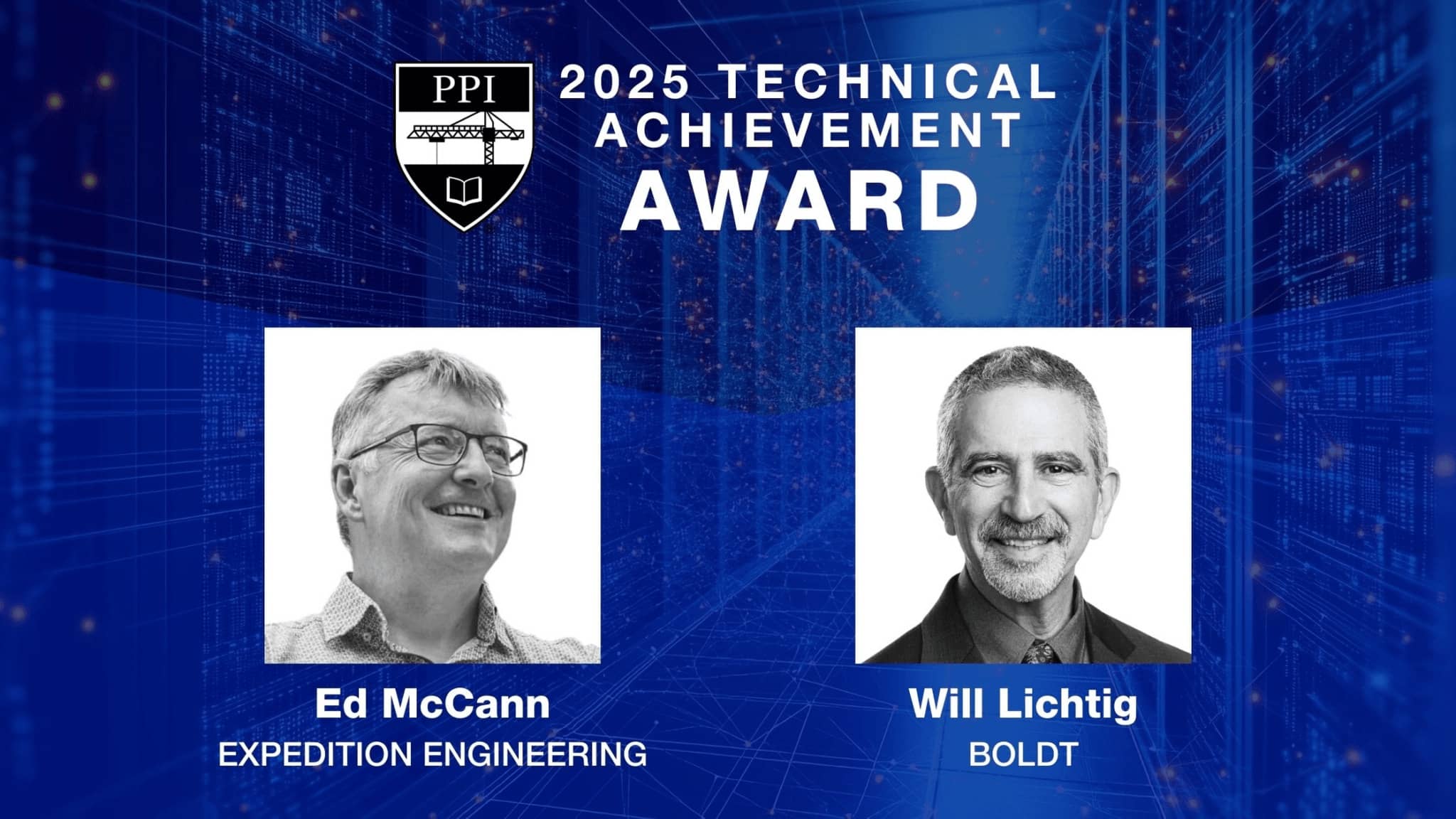
The Project Production Institute presents its first-ever dual Technical Achievement Awards to Ed McCann and Will Lichtig, recognizing their exceptional contributions to advancing project production management through industry leadership, lifelong learning, and practical application.
For the first time in its history, the Project Production Institute presented two Technical Achievement Awards, recognizing individuals whose exceptional contributions are advancing project production management in their spheres of influence. This year’s recipients, Ed McCann and Will Lichtig, exemplify the combination of intellectual curiosity, practical application, and industry leadership that drives real change.
Will’s philosophy centers on never figuring you have it right, only that you have it a little better, while constantly looking for what else can make the journey better, particularly for those bringing projects to life in the field.
[00:00:00] Gary Fischer, PE: We’re gonna do something just a little bit different now. Each year the Project Production Institute recognizes individuals who have made exceptional contributions to advancing the field of project production management. This year we, you know, we were faced with a very difficult choice. We had two folks who, in their sphere of influence or making really significant contribu.
[00:00:21] Gary Fischer, PE: So we decided to give two awards for the first time ever. You’ve heard from both this morning, and I think you can probably see why they’ve been selected for this prestigious award. So we’re gonna start with Ed, if you’d turn on your, uh, your, uh, camera there. Alright, ed, um I have a really nice award in hand for you.
[00:00:45] Gary Fischer, PE: Try to get it to show on the camera there. We’ll get this in your hands as soon as we can get the mail service to do it. Congratulations, well deserved, man. Your influence in the UK and changing how projects are formulated, managed, engineered, your focus on production and product and process design.
[00:01:06] Gary Fischer, PE: Bringing those together is just phenomenal. Just a huge. Positive influence for what we want to see happening in the world. So thank you for your sphere of influence. I’m really looking forward to seeing undoubtedly, what you’re gonna do next. Where are you gonna drive the industry? Getting that, um, that standard in place sounds like a huge milestone for the industry.
[00:01:30] Gary Fischer, PE: What was it called again? The R.
[00:01:34] Ed McCann: They, they in, it’s called a PAs, a publicly available specification. Effectively
[00:01:38] Gary Fischer, PE: national. Okay. There, it’s okay. And you, you think by this time next year, we’ll know if that’s gonna work or not?
[00:01:43] Ed McCann: We’ll, we’ll it’ll be in place by then. We’ll probably is 12 months after that.
[00:01:47] Ed McCann: We’ll see. But what’s, what’s interesting is the big infrastructure, big public sector, infra codes, basically all committed to adopting it. Yeah. So, uh, we, we’ve gotta make sure we’ve got the right stuff in it.
[00:01:58] Gary Fischer, PE: Yeah. Yeah. Which is just absolutely fabulous. So, congratulations, ed. I’ll turn it over to you if you wanna say a few words.
[00:02:05] Ed McCann: Well, look, I, I am really honored and thank you very much. Completely unexpected. Um I, well, as you probably would’ve picked up, I mean, I’m sort of fairly new to the, sort of formal, the science of all this and, and, and I watching other presentations of people obviously very. A, very developed understanding of factory physics and how that flows through into process mapping and modeling and so on.
[00:02:26] Ed McCann: And so, yeah, I confessed to feeling slightly fraudulent in this, but, but I, I, I, sort of, my, my general observation I, it was, you’ve probably picked up m. Finding this body of work, um, uh, flagged by Todd’s book in particular, but coming to know the work that you’re doing here and seeing this has been, it’s been quite pivotal in my understanding about what the next steps for the industry are.
[00:02:51] Ed McCann: I suppose about 35 years of looking at industry, actually probably getting worse, not better. Mm-hmm. And, uh, uh, feeling quite uncomfortable about that. And I, uh, there, I think there, there, I’m going. I’m gonna say two things we need to remember about this and, and that will certainly inform how I move forward, is one of them is that it’s a big complex system with lots and lots of people in interest in it.
[00:03:12] Ed McCann: Uh, there is no single magic bullet. This is a systemic challenge and it has to be understood as such. However, uh, in dealing with a big systemic challenge you need solutions and you need techniques to deal with all of the component issues. And in this world of production systems, engineering, production systems, controls, modeling and so on, I think we have there the solution that will allow us to grip, um, the process of build and supply chain management and all the stuff that’s been talked about this afternoon in a way.
[00:03:47] Ed McCann: Um, that will enable us hopefully in, the next 10 or 20 years to get this stuff really moving forward and sorted. But I, I confess it’s not gonna be enough. We’ve gotta sort out a whole load of other stuff as well to do with the way the clients contract and the, uh, and actually having people who can do this stuff well.
[00:04:04] Ed McCann: ’cause it’s, it’s all great on paper, but you need to be able to do it. But anyway, so many, many thanks, uh, um, and yes. Uh, I, I will, uh, yeah, well, we’ll be in touch as it goes. Thank you very much, Gary.
[00:04:16] Gary Fischer, PE: Absolutely. And we’re gonna see you here in the panel in just a second. So our other recipient is Will, so Will, can you turn on your camera,
[00:04:29] Gary Fischer, PE: Gary? He is. Will I have a, a similar Oh, memento, Eric Memento for you that we’ll get into your hands here shortly. You’re clearly a role model or the kinda leader that’s needed for an organization to transform. I think we saw that really clearly in your presentation earlier. Anybody that wants to emulate what Bolt’s doing needs to watch what Will says.
[00:04:54] Gary Fischer, PE: But more importantly what he does, I think he’s actions speak for his, uh, passion for getting better, transforming. Lifelong learning, I think is how I’d characterize you. So will turn it over to you for a few words.
[00:05:12] Will Lichtig: Thanks Gary. It it, it is been interesting to reflect on this for the last couple of days.
[00:05:16] Will Lichtig: I think, you know, you really captured it around these ideas of lifelong learning. I if people ask me what do you need to do is be curious and keep learning. Yeah. Um, folks out there may not know that I’m actually a lawyer by training, but an innovator by birth. I came to the construction industry actually as a construction lawyer for 25 years, and then what happened is I became increasingly dissatisfied with the results that I was having to clean up the mess on construction projects.
[00:05:44] Will Lichtig: And so I began a effort in the early two thousands, late 1990s to try to figure out what really led to successful projects rather than failed projects. I often say that lawyers are students of failed projects. Stumbled upon, uh, the work of the Lean Construction Institute befriended Greg, how, and Glen Ballard mm-hmm.
[00:06:06] Will Lichtig: Uh, came to know Iris timeline and, and, uh, and Todd Zabell at about the same time. And again, it’s been a, a constant evolution in learning, never figuring that you have it right, always figuring you have it a little better, but constantly looking for what else. Can make this journey and, and the ability to create within the built environment better, not just for those that sit of us, that sit in the office, but in particular for those that are bringing it to life in the field.
[00:06:35] Will Lichtig: So it’s, it’s, uh, been a pleasure. Again, I think that it, for anybody else out there, it’s not, it’s never easy, but that doesn’t mean it isn’t rewarding. Um, there are a lot of challenges along the way. You have as many challenges as you have successes but you rarely learn from your successes as much as you do from the challenges or the obstacles that you have to address and overcome.
[00:06:58] Will Lichtig: So again, thanks Gary. I appreciate the recognition and, uh, hope to continue to contribute as we continue to move forward.
[00:07:05] Gary Fischer, PE: I’m confident you will. Congratulations again.

PPI works to increase the value Engineering and Construction provides to the economy and society. PPI researches and disseminates knowledge related to the application of Project Production Management (PPM) and technology for the optimization of complex and critical energy, industrial and civil infrastructure projects.
The Project Production Institute (PPI) exists to enhance the value Engineering and Construction provides to the economy and society. We are working to:
1) Make PPM the dominant paradigm for the delivery of capital projects,
2) Have project professionals use PPM principles, methods and tools in their everyday work,
3) Create a thriving market for PPM services and tools,
4) Fund and advance global PPM research, development and education (higher and trade), and
5) Ensure PPM is acknowledged, required and specified as a standard by government and regulatory agencies.
To that end, the Institute partners with leading universities to conduct research and educate students and professionals, produces an annual Journal to disseminate knowledge, and hosts events and webinars around the world to discuss pertinent and timely topics related to PPM. In order to advance PPM through access and insight, the Institute’s Industry Council consists of experts and leaders from companies such as Chevron, Google, Microsoft and Merck.
Join us in eliminating chronic poor project delivery performance. Become a member today.